The Ancestry, Or Origins, Of Shikellamy
"July 10, 1743 - He was of the Six Nations, or rather a Frenchman born at Montreal, and adopted by the Oneidas after being taken prisoner, but his son tole me that he [the son] was of the Cauyga Nations" -
The Journal of John Bartram, who accompanied Conrad Weiser and Lewis Evans to Onondaga in 1743.
"When he was spoken to concerning baptism, he said that he had been baptized in infancy. We were informed afterward that he was born of European parents in French Canada, taken prisoner when a chilce two years old, and brought up among the Indians. He was so much altered in his way of life that he was hardly distinguished from the savages"
- Dr Crantz, History Of The Bretheren, 1768
"The Six Nations called him Swatane. He belonged to the tribe of the Bear. When and where he was born is unknown, but it is likely that he first saw the light of day in some part of what is now the State Of New York." - Otzinachson by Meginness, pg 126
His name is a much corrupted form of the Oneida chieftan title, Ongwaternohiat-he, meaning" It has caused the sky to be light for us".
The other name, Swataney, is a corrupt form of Onkhiswathe-tani - "He causes it to be light for us."
 |
| The Shikellamy Statue at the Conrad Weiser Homestead |
One day Shickellamy said to Conrad Weiser, ‘I have had a dream. I dreamed that Tarachiawagon gave me a new rifle.’ Conrad, who owed much of his success to his strict observance of Indian etiquette (which believed all dreams would eventually come true), is said to have answered the dream with the rifle, and then to have spoken for himself. ‘I, too, have had a dream,’ he said. ‘I dreamed that Shickellamy gave me an island in the Susquehanna,’ and he indicated the Island of Que at the mouth of Penn’s Creek, on the site of what is now the town of Selinsgrove. The old chief, we are told, matched Weiser’s politeness, but, ‘Conrad,’ he said, ‘let us never dream again.’ - An old, oral tradition recorded in, Conrad Weiser, Friend of Colonist and Mohawk (p 52) by Paul A. W. Wallace
What Meginness had to say about the Dream story, From Otzinachson by Meginness, Page 127:
It is not believed that this story ever occurred . It is true, however, that the Isle of Que, on which a part of Selinsgrove now stands, had been owned by the old interpreter , and that it remained for one or two generations in the possession of his descendants ; but there is no proof that his title rested on a mere dream . On the other hand , it is true that Shikellimy had been very poor, so poor that Conrad Weiser interceded for him as an object of charity before the council at Philadelphia .
The following, however, is said to have been true: “ Conrad Weiser once sat residing on a log in his extensive forest land. An Indian came and sat down along him . Conrad moved to one side somewhat; the intruder pressed harder against Again Conrad made more room , but the Indian still moved after him . Then Conrad demanded an explanation of his strange and rude procedure. The Indian answered : “Thus the whites did to the Indians. They lighted unbidden on our lands. We moved on ; they followed. We still moved and they still followed . We are moving onward now, and they are following after. Conrad , I will not push you off the log entirely . But will your people cease their crowding, ere we roll into the waters ? ' " - Life of Weiser, pages 106 - 7

The Life Of Shikellamy
Shikellamy was trained in war, and for his valor was rewarded by adoption into the Oneida tribe, of which he became Chief. This was an exceptional distinction for one who was not a member of the tribe, and possibly not a full blooded Indian by birth.
Shikellamy was not present for the treaty with the Five Nations in Philadelphia. The first conference he took part in was July 4-5 1728 in Philadelphia, but he does not appear to have taken any part in those proceedings. After a similar conference in October of 1728, the council considered "what present might be proper to be made to Shikellamy of the Five Nations, appointed to reside among the Shawnese who services had been and may yet further be of great advantage to this government."
"At the close of a conference several years later [after 1728], the Governor having represented that Shikellamy was 'a trusty good man and a great lover of the English', commissioned him as a bearer of a present to the Six Nations and a message inviting them to visit Philadelphia. This they accordingly accepted, arriving August 18 1732.
Shikellamy was present on this occasion and he and Conrad Weiser were employed to transact business between the Indians and the Provincial Government. He [Shikellamy] was a great friend of James Logan, and named one of his sons after this popular provincial officer"
"One of the Chief facts of his life as a viceregent of the Iroquois confederation was his great friendliness to the cause of the Moravian missionaries among the Indians. All the prominent leaders of the Moravian Church who came to the Susquehanna region visited him at his home at Shamokin [current day Sunbury] and were kindly received. Count Zinzindorf was among these and none was more favorably impressed with the old Oneida diplomat."
"He was truly an excellent and good man, possessed of many noble qualities of mind that would do honor to many white men, laying claims to refinement and intelligence. He was possessed of great dignity, sobriety, and prudence, and was particularly noted for his extreme kindness to the inhabitants with whom he came in contact." - The Journal of Count Zinzindorf, 1742
"In the death of Shikellimy the whites lost the best and truest friend they ever had among the Indians in this lovely valley."
- Meginness, in Otzinachson, 1899
A Profile of Shikellimy
From Otzinachson by Meginness, 1889, pages 125-128
"The first we hear of him was in 1728 , when he was living on the West Branch. In 1737 he was living in his village, a short distance below Milton , on the west side of the river , the site of which is illustrated on page 62. At that time he appears to have been in the full flush and vigor of manhood. As he possessed an executive mind , and was recognized by his people as a man of much more than ordinary ability , his counsel was eagerly sought by the government of the Six Nations; and as this section of their confederation was somewhat hard to govern, on account of the various tribes inhabiting it , and the conflicting interests which had to be regulated , he was designated at an early period as leading sachem or vicegerent, and invested with more than ordinary authority . As early as 1745 he estalished his seat at Shamokin , as that place was recognized as the central or converging point. On account of his high standing and excellent judgment, his influence was courted by the Provincial authorities. So great was his love for truth and justice that he never violated his word nor condoned a crime. There was scarcely a treaty held for the purchase of lands, from 1728 to 1748,that he did not attend , and his wise counsels aided in amicable solutions of what sometimes threatened to be troublesome questions.
The acquaintance which Zeisberger made with him was care fully followed up by the Brethren and ripened into a friendship which ceased only with the death of the noble old chief. His numerous trips as guide and interpreter with the Moravians show the great confidence that was reposed in him , and the high esteem in which he was held . He was also the warm friend and confidant of Conrad Weiser , and they were always fast friends. Many anecdotes are related concerning them .
While on his last visit to Bethlehem , in 1747, he experienced the power of divine grace and made a profession of personal faith . He had been baptized in Canada, by a Jesuit father, many years before. Laying aside a Manitou, the last relic of his idolatry, he took his way rejoicing to his home on the Susquehanna. It was on the occasion of this visit that the Brethren , before his departure, presented him with a new blue cloth waistcoat, and a red one for his grandson. These tokens of love pleased him very much and he felt grateful towards the donors.
In the death of Shikellimy the whites lost the best and truest friend they ever had among the Indians in this lovely valley.
Loskiel, the historian, who knew him well, pays this glowing tribute to his character and worth :“ Being the first magistrate and head chief of all the Iroquois Indians living on the banks of the Susquehanna, as far as Onun daga , he thought it incumbent upon him to be very circumspect in his dealings with the white people. He mistrusted the Brethren at first , but upon discovering their sincerity , becametheir firm and real friend. Being much engaged in political affairs, he had learned the art of concealing his sentiments; and, therefore ,never contradicted those who endeavored to prejudice his mind against the missionaries, though he always suspected their motives. In the last years of his life he became less reserved , and received those Brethren who came to Shamokin into his house. He assisted them in building , and defended them against the insults of the drunken Indians; being himself never addicted to drinking, be cause, as he expressed it, he never wished to become a fool. He had built his house upon pillars for safety , in which he always shut himself up when any drunken frolic was going on in the village.
In this house Bishop Johannes Von Watteville and his company visited and preached the gospel to him . It was then that the Lord opened his heart. He listened with great attention ; and at last, with tears, respected the doctrine of a crucified Jesus, and received it in faith . During his visit in Bethlehem , a remarkable change took place in his heart which he could not conceal. He found comfort, peace and joy, by faith in his Redeemer, and the brethren considered him as a candidate for baptism ; but hearing at he had already been baptized, by a Roman Catholic priest in Canada, they only endeavored to impress his mind with a proper a of his sacramental ordinance , upon which he destroyed a small idol, which he wore about his neck . After his return to Shamokin , the grace of God bestowed upon him was truly manifest, and his behavior was remarkably peaceable and contented. This state of mind he was taken ill, was attended by Br. David Zeisberger, and in his presence fell happy asleep in the Lord, in 1 assurance of obtaining eternal life through the merits of Jesus Christ."
"Being the first magistrate and head chief of all of the Iroquois Indians living on the banks of the Susquehanna as far as Onodaga, he thought it incumbent upon him to be very circumspect in his dealing with white people. He assisted the missionaries in building, and defended them against the insults of drunken Indians; being himself never addicted to drinking, because, as he expressed it, he never wished to become a fool" - Loskiel
Shikellamy had built his house upon pillars, for safety, in which he always shut himself up when any drunken frolic was going on in the village.
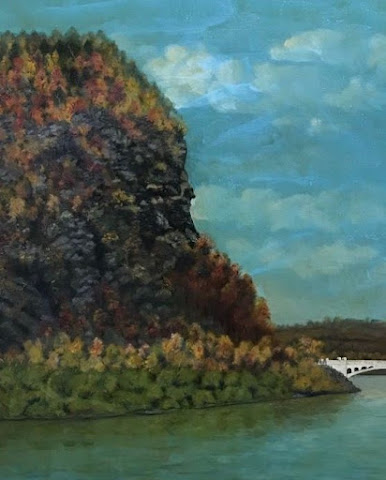
"Half up these rocks, conspicuous in place
Times had has chisell'd Shikalamys face"
Shikalamy, from Legends Of The Susquehanna & Other Poems, by Truman H. Purdy
SHIKALAMY
============
EXPLANATORY
The Six Nations of Indians were a confederation of six powerful tribes, composed of the Mohawks, Oneidas, Cayugas, and Senecas, to whom were added, in 1712, the Tuscaroras, with the Delawares as a conquered tribe, composed of the Turkeys, Turtles, Wolfs, and Muncys. They ruled the country from the St. Lawrence to the Carolinas, and from the mouth of the Hudson westward beyond the limits
of Pennsylvania.
Shikalamy was the head chief, with his residence at Shamokin (now Sunbury), Pennsylvania. He was baptized by a Catholic priest in Canada, but afterwards became a convert under the preaching of Moravian missionaries from Bethlehem, — embracing their creed and faith. He married Nenaoma,
a beautiful Indian woman, and had one daughter and three sons ; one of whom was Logan, who inherited the noble presence of his father, and whose family was murdered in
Virginia by whites in 1774. A six years' war followed, at the close of which he refused to ask for mercy, but made instead that memorable address, in which he said, —
" I appeal to any white man to say if ever he entered Logan's cabin hungry and he gave him no meat, if ever he came cold and naked and he clothed him not. . . . For my country I rejoice at the beams of peace ; but do not harbor the thought that mine is the joy of fear. Logan never felt fear."
Shikalamy was a just man, of great ability, a firm friend of the whites, and a constant adviser and promoter of peace. He died at Shamokin, in the full triumphs of Christian faith, in April, 1749, t and was buried with great solemnity in the old Indian burying-ground on the cape, at the east
side of the junction of the Susquehanna Rivers, lamented by the English king, by provincial governors, and by the people whom he had so long and wisely ruled. War followed his death, and by 1796 the Indian titles were all extinguished, and the Six Nations emigrated to Canada and the far West.
This explanatory is followed by more than 20 pages including a poem, and illustrations, about Shikellamy. See the entire selection here:

The Death Of Shikellamy
Shikellamy died on December17, 1748, with his daughter and Rev. David Zeisburger with him when he took his last breath. At the time of his death he was thought to be "65 or 68 years of age, which is quite old for an Indian"
Bishop Zeisberger and Henry Fry made him a coffin, and the Indians painted the body in their gayest colors, bedecked with his choicest ornaments, and placed with him his weapons, according to Indian custom. Christian rites were then performed by the Bishop, and he was buried in the Indian burying grounds of his people, near the site of old Fort Augusta.
Shikellamy's son Unhappy Jake had been killed in the war with the Catawba in 1743. Three sons and one daughter remained at the time of Shikellamys death in 1748:
The Daughter was the widow of Cajades, "The Best Hunter Among All Of the Indians" who had died the year before, November 1747.
Taghneghdoarus, or John Shikellamy, "who succeeded his distinguished father in authority but never gained the confidence in which he was helf by the Indians or Whites"
Tahgahjute, or Sauyghotowa, known as James Logan - "the most celebrated of the children of Shikellamy"
John Petty
"He had four sons: 1 , Tachnechtoris , a wide spreading oak , who was also called John, of the tribe of the Turtle ; 2, Arahhot;* 3, Sajechtowa , alias James Logan ; 4 , John Petty , named after a trader. We know that he had one daughter, for the Moravians inform us that she was present when he died. * In 1744 Shikellimy lost a son in the war with the Catawbas. Hewas called “ Unhappy Jake," and his father took his death “ very hard,” according to Weiser ,and the Governor sent him some small presents to " wipe off the old man ' s tears and comfort his heart.”' - Otzinachson by Meginness pg 126

1820 Painting Representing Shikellamy
Statement of Jesse Logan, aged 106 years old and Great Grandson of Chief Shikellamy
Cornplanter Reservation, Penn
October 9, 1915
"I was born on the West Bank of the Allegheny River, in the Cornplanter Reservation, in 1809, the same year as Abraham Lincoln. My father was John Logan, Jr., a Cayuga, the only surviving child of Captain John Logan, the oldest son of Shikellamy. My mother was a daughter of the Seneca Chief Cornplanter. My father after retiring from the war path, settled at Cold Spring, in the Allegheny Reservation, in New York State, where he died in 1844 aged 100 years. Early in life he married Annie, a daughter of Cornplanter, who bore him fine children, three daughters and two sons. The last were names Lyman and Jesse. When my grandfather was old he came to this Reservation, where he lived with my father until his death. To the best of my knowledge, he died in this reservation, and is buried near the grave of Chief Cornplanter. I married Susan, a Seneca maid, and we had one child, James Logan, who died at the age of thirty. He was named for my great-uncle, the immortal Cayuga orator. Physically, my father and my son were small men, much smaller than my grandfather and my great-uncle. I took after my grandfather, as I am of large stature. I remember Cornplanter, my maternal grandfather, very well. He was a large, strong man, not dark in color, and with grey eyes. He was a great man for work. Every morning, winter or summer, rain or shine, at six o'clock he would come out of his house and ring a big dinner bell as a signal for all to get busy. He wore a red cap much the same as the white hunters do now. I remember Philip Tomb, the great elk and panther hunter, who lived a mile up the river. I hunted elk with the famous Jim Jacobs many times. I was taught to hunt by my grandfather, who died in 1820. He was a very old man when I was very young, but I recall what he looked like. I killed hundreds of elk, many bear and deer, and quite a few panthers, the last in 1860. I have always been fond of sports. I walk two miles to town (Corydon) every time there is a baseball game. As a boy I excelled at the Indian games of long ball and snow snake. I love a joke and enjoy a good dinner. I use tobacco and liquor sparingly. I attribute my long life to my love of outdoor exercise and hunting and fishing. In my old age I am well cared for by my Indian friends, but regret that 'my blood flows not in any living person,' to use the language of my great-uncle James. There are many Logans in the Reservations in Pennsylvania and New York; some are descended from my brother and sisters, others adopted the name because of the honor attached to it. I wish I had been invited to attend the unveiling of my great-grandfather's [Shikellamy's] monument in Sunbury next week, but I guess that the world has forgotten Logan. I tried to fight for the white man in the Civil War, but when I got to Harrisburg I was sent back as too old. But I was a dead shot, and can still beat men one-quarter of my age with the gun and bow and arrow. Next summer, if I live I hope to visit Logan Valley, where my grandfather resided, and view the scenes that my father loved to talk about. I would also like to visit Mrs. Gross, at Fort Augusta, who has done so much to honor Shikellamy's memory. I have lived a long while, but I am not tired of life, and each day seems new and pleasant to me."
=============

=============
READ MORE
=============


A platform was erected on the Fort Augusta side of the river, for viewing the profile of Shikellamy. For a few years, bands and other entertainment would perform on the platform.


At the mouth of Chillisquaque * Creek there was a small Indian village. Conrad Weiser, as early as 1737,made a journey up the river while en-route for Onondaga. On the 7th of March he writes in his journal:
An old Shawano by name Jenoniawano, took us in his canoe across the creek at Zilly Squache (Chillisquaque). On the 8th we reached the village where Shikelimo lives, who was appointed to be my companion and guide in the journey . He was, however, far from home on a hunt. Weather became bad and the waters high , and no Indian could be induced to seek Shikelimo until the 12th , when two young Indians agreed to go out in search of him . On the 16th they returned with word that Shikelimo would be back next day, which so happened . The Indians were out of provisions at this place . I saw a new blanket given for about one-third of a bushel of Indian corn.
Hon. John Blair Linn, in his Annals of Buffalo Valley, thinks there is no doubt but Shikellimy's village was located on the farm of Hon. George F . Miller, at the mouth of Sinking Run, or Shikellimy's Run, as it was formerly called , at the old ferry, one half mile below Milton, on the Union County side. The Reading Railroad now runs through where it probably stood. It is abeautiful spot for a village, as it was protected on the north by a range of hills , with the river much narrowed in front, giving easy access to the Northumberland side.
On the other side of the river from Shikellimy's town, and nearly opposite the mouth of Buffalo Creek , on the Nesbit farm ,the early settlers discovered an Indian mound which had been used for burial purposes. It was twenty - five or thirty feet in diameter. When it was opened it was found to have a floor laid with flat stones, on which the bodies of the dead appeared to have been placed in a sitting posture. This was evident from the fact that the skulls all rested on top of the other bones. When the bones were exposed to the air they soon crumbled to dust. The tomb contained no implements of war, but a few rude stone pipes were found. On the summit of this mound an ash tree was growing, when it was opened, — more than fifty years ago , — which was hollow . The concentric circles in the solid part of the trunk showed it to be 70 years of age. The tree was probably much older and had grown on the mound after it was thrown up. When or by what tribe it was built is unknown. But that the
builders belonged to a pre -historic race there is no doubt.
* Corrupted from Chililisuagi, signifying the place of snow birds. - Heckewelder. Scull's map locates an Indian village of the same name at the mouth of the creek . Conrad Weiser says in his journal that when the old Indian ferried him in his canoe across the creek , he gave him some needles and a pair of shoe strings.


