NARROW-GAUGE RAILROADING IN
UNION COUNTY
BY JOHN D. DENNEY, JR. [1950}
The story of the narrow-gauge at White Deer goes back before
the turn of the century. The Duncan Lumber Company in the nineties was cutting lumber in the vicinity of Paddy's Mountain in Mifflin County. The company operated a narrow-gauge
railway, using wooden tracks, to haul the lumber out to the Pennsylvania Railroad at Paddy's Mountain station. When the supply of timber on this tract gradually declined, however, the Duncan Lumber Company, in March of 1899, transferred operations to White Deer village, across the Susquehanna River from Watsontown.
A narrow-gauge railroad was con structed by the John F. Duncan Lumber Co. along the White
Deer Creek solely to facilitate the removal of timber from the nearby mountains.
It was operated just as a logging railroad under private management.
After the untimely death of Mr. Duncan, however, the lumber
operations were sold out to the Whitmer-Steele lumber interests
at Sunbury, Pennsylvania. Then the narrow-gauge lumber railroad
at White Deer was incorporated as the "White Deer and Loganton
Railway," on April 17, 1906. The Duncan interests had operated
the road, which had been known as the White Deer Valley Railroad,
from White Deer into Duncan, some fifteen miles. The new
owners, during 1906 and 1907, extended the trackage from Duncan
to Loganton, Pennsylvania, twenty-four miles from White
Deer. The first narrow-gauge train ran from White Deer to
Loganton on May 1, 1907. The new operators of the road included
Charles Steele, president; Harry Steele, vice-president;
and Elmer Crissman as superintendent.
The new railroad meant much to the people of Loganton and
the area known as Sugar Valley. Prior to the coming of the
railroad, all supplies and merchandise had to be brought in over
the mountains by wagons from Lock Haven. The narrow-gauge
gave Loganton an outlet on the Williamsport-Shamokin line of
the Reading Railroad at White Deer. Thus these small railroads
played a great part in the development of the wilder, more remote sections of the state, before the coming of the automobile
and fine highways of the present day.
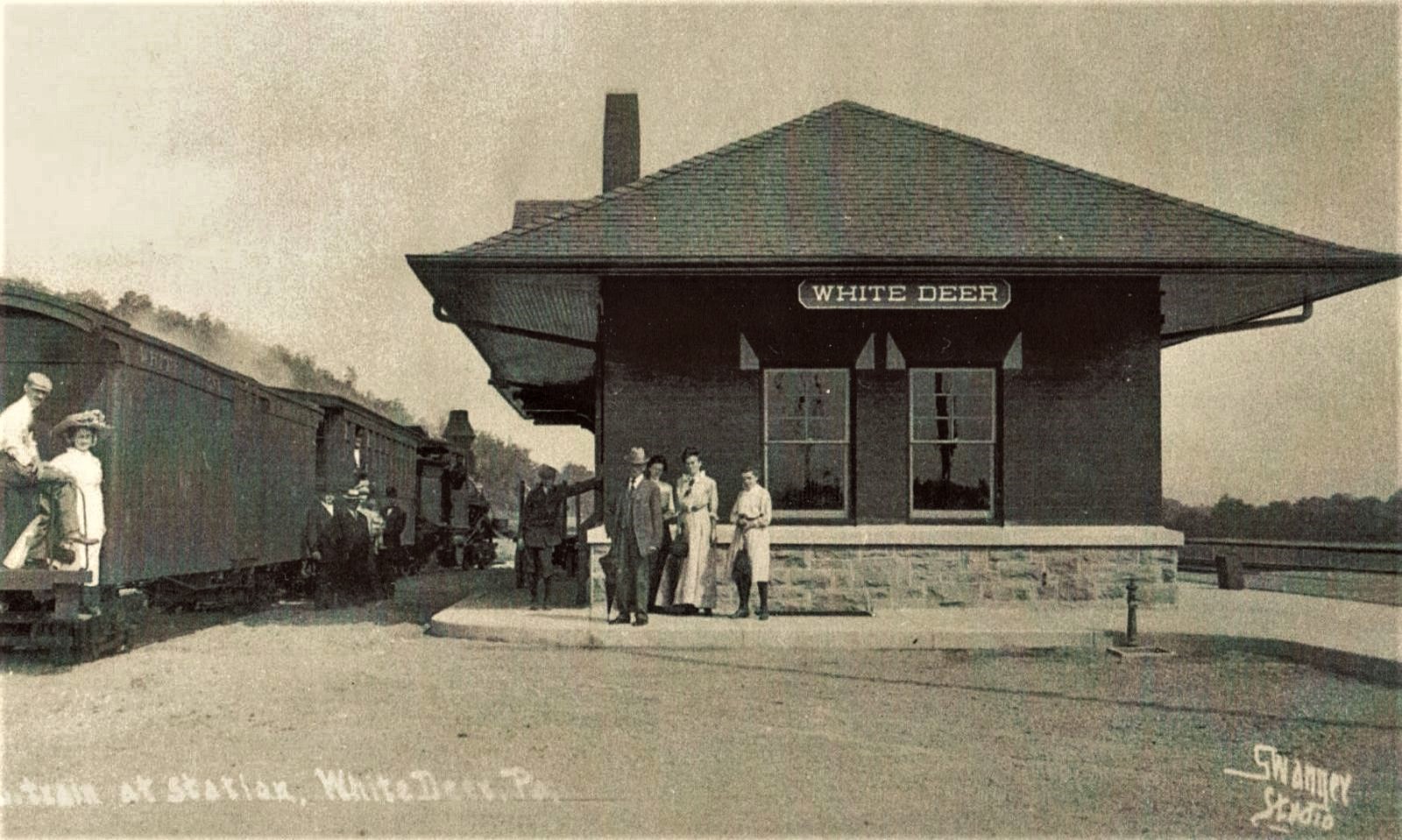
The Loganton narrow-gauge commenced right beside the Reading
station at White Deer. The three-foot-gauge tracks ran north
along the Reading for about one half mile to a point known as
White Deer Junction, before turning westward and heading into
the forests. The Reading agent at White Deer did all of the station
business for the W. D. & L., including the freight billing and the
ticket work. Of course, at White Deer, all shipments had to be
unloaded from the narrow-gauge cars and reloaded onto the
Reading Railroad cars. The narrow-gauge maintained a large
building at White Deer Junction, where the locomotives could be
stored when not in use, or where repairs could be made.
The section through which the little railroad operated was a
very scenic wooded area. The roadbed followed the White Deer
Creek, which was well known in Central Pennsylvania for its
"speckled" or brook trout. The timetable of the line showed such
stations as Clam Bake Springs, Lick Run, Mile Run, Zimmerman
(or Duncan), Tea Springs, Green's Gap and Carroll. Yet these
were only small "flag" stops, with little more than a waiting
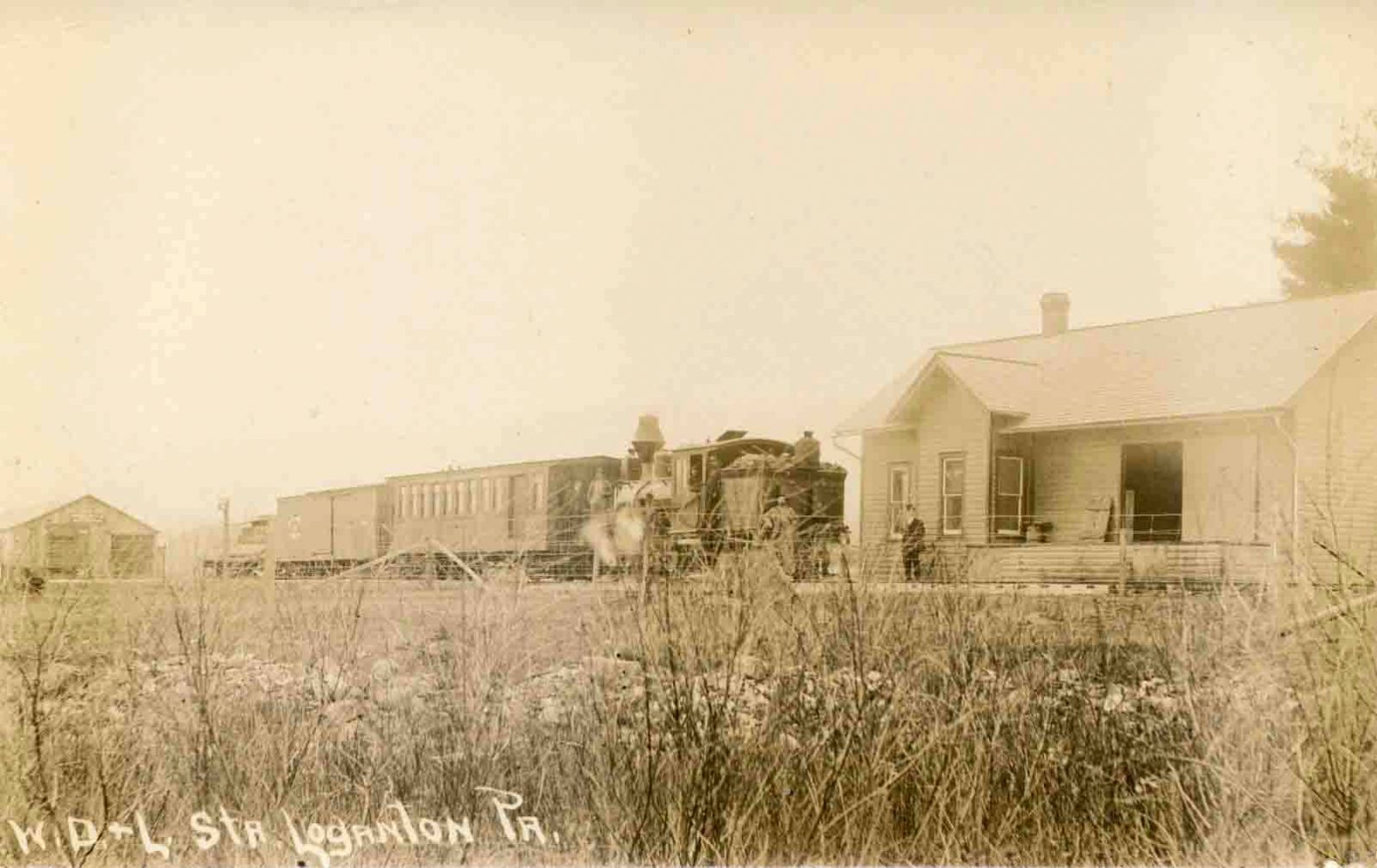
place for the train. At the town of Loganton, the railroad maintained
its own station and an agent who handled the tickets,
freight billing and express business. There were also branches
built from the "main line" at Mile Run, Zimmerman's and Green's
Gap. These lines were used by the White Deer Lumber Company
in moving timber from the Nittany Mountains in that area.
When the railroad was first opened, there were two passenger
trains a day into Loganton. After about two years, however, this
schedule was changed to one train a day for passengers. It took two
hours and twenty minutes for the train to creep over the twentyfour
miles of thirty-pound narrow-gauge rails. Trains usually
stopped at the station of Tea Springs to take water. Although there
was only one passenger schedule operated, there were two log trains
operated on an irregular schedule by the White Deer Lumber
Company. A heavy tonnage of white and yellow pine lumber was
taken out of that area yearly. The White Deer and Loganton and
the White Deer Lumber Company were controlled by the same
interests. Therefore the line was built much on the style of a
lumber railroad, with light rails and not too much heavy grading.
Four rather unique locomotives were used on the line, although
only two actually carried the lettering, "White Deer and
Loganton Railway." These two engines were numbered "one" and
"two" and were of the Climax, or geared type. This type of locomotive
was built by the old Climax Manufacturing Company of
Corry, and was the outcome of a demand for an engine with
great traction power and flexibility, for use on light, cheaply constructed
track. They could burn either wood or coal for fuel, were
equipped with large stacks, and carried the large, square, oil-burning
headlights. Now, engines "three" and "four" were owned by
the White Deer Lumber Company. The "three" was similar to
"one" and "two," but "engine four" was really an oddity.
"Engine four" was known as the "boxcar" locomotive. Technically,
it was known as a verticle-boilered Climax, built by the
company at Corry. The frame of the engine was just like a box
car with the boiler in a verticle position, with the pistons and
other parts of the engine several feet to the left. The coal box
was at one end of the locomotive while the water tank was at
the other end. These locomotives were rather light but, nevertheless,
they were powerful on the steep grades that were often found
on lumber railroads. Engines of the type could be even operated
on wooden rails or log "pole" roads if necessary. The four engines
were interchanged between the logging railroad of the White
Deer Lumber Company and the line of the W. D. & L., although
the box-car engine was maintained primarily for negotiating the
steep grades and the sharp curves on the various lumber operations.
It had originally been brought from the Duncan lumber company
over at Paddy's Mountain.
Nevertheless, the White Deer and Loganton had its share of
passenger business. The company had four passenger cars. One
was a regular type passenger coach while the other was a combination,
passenger and baggage. They were built by an eastern
manufacturer. These cars had narrow treads on the wheels and
low flanges and thus gave quite a bit of trouble, making it difficult
to keep the cars on the tracks. Then the company carpenters
were put to work and they turned out a home-made coach, a
milk-express car, and an open excursion car for summer use. These
had wheels with wide treads and high flanges similar to wheels
on log cars and were more satisfactory. Excursions and specials
were operated to Tea Springs, a pretty picnic spot in the woods,
where there was a pavilion and facilities for outings, dances and
picnic gatherings. The village of Loganton and the various lumber
camps also were sources of passenger revenue. Then, too, the
American Express Company transacted business over the narrow-
gauge.
Sources:
WHITE DEER AND LOGANTON RAILWAY:
- Correspondence and Interviews: W. W. Campbell, Northumberland, Pa.,
- former Reading agent at White Deer, son of former W. D. & L. engineer;
- Charles Steele, Northumberland, Pa., owner of the W. D. & L.; Mrs. Walter
- Sheltman, West Milton, Pa., family connected with the lumber operations
- at White Deer; Lewis Wilkins, White Deer, Pa., former engineer.
- Publications: White Deer and Loganton Timetable, effect July 6, 1915;
- Poor's and Moody's Manuals of Railroads