Showing posts with label Washingtonville. Show all posts

Saturday, May 18, 2024

Jane Delong Memorial Hall & Delong Museum

Jane Delong Memorial Hall & Delong Museum

1129 Third St, Washingtonville, PA 17884

Named for Frank Delong's mother, the museum downstairs holds a large portrait of the buildings namesake. (When open, access the museum by walking to the left of the building, it will be the first set of doors on the right, at ground level).  For more information on hours, or using the facility, contacting the Columbia Montour Visitors Center may be your best bet.  The museum has no online presence, no website nor social media.  But like much of our area, it's a hidden gem, worth the visit, if you can get there.


DeLong purchased the church for $500, and then poured $3500 into it, digging a well, replacing the floors, and putting in new lighting, heat and plumbing, before giving the building to the community in 1928.
  It exists as a community hall yet today, with the annual Christmas parties being revived in recent years.  The upstairs is used for events, as well as by the Riverstage Theatre Company for some of their performances.


Downstairs is a historical museum, including Delongs library, a helmet worn by Charles Lindbergh in a cross country flight, and more.  

The Charles Lindbergh display at the Jane Delong Memorial Hall

The truck on the left is one of the many items Frank Delong gifted  to local children over the years.

=====================


Thursday, April 25, 2024

The Washingtonville Truss Bridge

 
On a recent drive home, I took the long way, and stopped to read the sign over the bridge here in Washingtonville.  This is on Bush road leading south off 54.

Thursday, March 21, 2024

Washingtonville Lime Kilns

 
Lime Kilns south of Washingtonville
These are just down the road from what was once Frank Delong's Home in Washingtonville.

The address for these is 300 Bush Road, Danville Pa.  Although a Danville address, this is closer to Washingtonville than to the Danville borough.

In Limestones of Pennsylvania By Benjamin LeRoy Miller · 1925, under Washingtonville, Miller says:
"The two main quarries in this area are about two miles southwest of the town of Washingtonville.  They are along Limestone ridge.  No detailed reports of these quarries  are available because they were not working at the time of the visit."

Bush road does appear to be roughly 2 miles south west of Washingtonville.

February 1872, Charles Mufflet suffocated in Lime Kiln at Washingtonville


See more of the  lime kilns in our area, here:

===================
READ MORE


Sunday, October 23, 2022

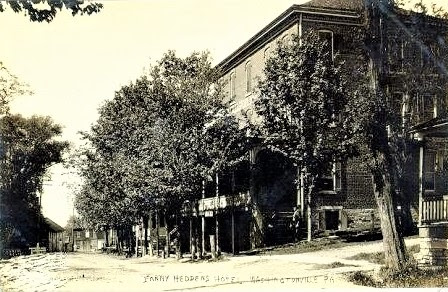
The Excelsior - Fanny Heddens Hotel in Washingtonville

Fanny Heddens Hotel, Washingtonville, PA

James T. Heddens, a tailor, opened the  Excelsior Hotel in Washingtonville  in 1837.  He operated the hotel, in addition to his tailoring business', for 40 years.   Following his death, his wife Fanny continued to manage the hotel. Fannie was one of the most popular hotel keepers in the county and the “Fannie Heddens Hotel” saw many diners, arriving on horse and buggy from Danville and Bloomsburg. In  1906 the hotel was purchased bby E.E. Freymeyer who continued to operate it until it closed in 1920.

The original frame building was replaced by a brick building, which burned down around 1891.  The hotel was rebuilt at the same location, and still stands today.  

Sunday, August 21, 2022

The Montour County Fair - Montour Delong

 
The Montour Delong Fair website tells us that the first Montour Delong Fair was held at the Delong Memorial School in 1935.  That was not however, the first Montour County Fair, nor was it the first fair to be held in Washingtonville.  

The first mention I could find of a Montour County Fair was in an 1853 edition of the Sunbury American, where it referenced the "late fair at Danville."  The next mention was in 1858, when the Montour County Fair opened in Washingtonville. The fair that year was held "at the mouth of the Mahoning Creek, and later fairs were held at Washingtonville." 

Fairgrounds on the 1867 Map

 In 1860, the new "Montour County Agricultural Fair" opened in Danville, and an annual  fair was held there through 1899. In 1900, that association folded and the fairgrounds in Danville were to be sold.

 Beers 1915 History tells us - "In the course of time, a difference arose between the representatives from the town and country and the society divided, the Northern Montour Agricultural Society being organized.  The headquarters of the latter are at Washingtonville, where the annual fairs were held.  The Montour County Agricultural Society held annual fairs in Danville.  "

===========
A Time Line Of the Montour County Fairs
===============

  • 1853 - The Sunbury American reported that the Fair at Milton "was not what it should have been, especially in its arrangements, and the same is said of the late fair at Danville"
  • 1856 - Montour County Agricultural Society was organized Feb 18th 1856
  • 1858 - Montour County Fair opened at Washingtonville, September 28-Oct 1
  • 1859 - Montour Agricultural Fair held at Danville, Oct 5-7th
  • 1860 - Montour County Fair held at Washingtonville, 3-5th of October
  • 1870 - First annual Montour County Agricultural Fair held
  • 1879 - Montour County Fair held at Danville Sept 24-27th. "The Northern Montour Fair commenced yesterday at Washingtonville... nearly all places of business will close Friday afternoon allowing the merchants to visit the fair."
  • 1882 - Montour County Fair Oct 4-7, held at Danville
  • 1884 - Fair held at Danville, Closed on the second day on account of wet weather.  Would open again on the 28th and continue for 4 days.
  • 1885 - Montour County Fair at Washingtonville.  Advertised the racehorse "Maud S.", and "palmed off a Danville horse by the same name.  A large number of gamblers were arrested on the grounds." https://susquehannavalley.blogspot.com/2020/10/when-fake-race-horse-came-to.html
  • 1886 - 16th Annual Montour County Agricultural Society Fair held at Danville, Oct 6th-9th
  • 1891 - Fair held in Danville October 6-9
  • 1896 - Fair held at Danville October 21-24
  • 1900 - Meeting was held to discuss the feasibility of reorganizing the Montour Agricultural Fair. Grounds owned by J.L. Riehl.  Not enough interest was garnered, the grounds were to be sold.
  • 1907 - An article in a Chambersburg newspaper reported "Edward Pentz... a resident of Danville, has purchased the old Montour fair grounds at Danville and will re-establish the annual county fair there."
  • 1915 - "At present there are no fairs held in Montour County, most of hte people attending the Bloomsburg Fair." -J. H. Beers & Company, 1915.
  • 1935 - The first fair by the new Montour Delong Fair Association was held October 24-26, at the Delong Memorial School
  • 1942-1945 - No fairs were held during World War II.
  • 1968- The Fair was moved to August
"It is the purpose of the directors of the Montour-Delong Fair Association to maintain the fair as an educational institution, rather than allow it to expand into a midway entertainment type of organization." Danville Morning News Oct 1935

1966 Advertisement

1977

August 20 1977

==========
READ MORE
===========

1884

1886

1900

June 1900

1935

Wednesday, July 14, 2021

The Hailstorm of 1871

On July 16 1871, a severe hailstorm ravaged the area from Crescent, through Montoursville, Turbotville, and Washingtonville.  Birds and livestock were killed, many roofs were full of holes, and hail was a foot thick on the ground.

Thursday, November 12, 2020

Washingtonville Station

Washingtonville Railroad Station, Washingtonville Pa

"Washingtonville, Montour County, is seen far to the right, after a run of eleven miles has been made from Watsontown. The Washingtonville station was first named "Let-Her-Go," because the residents of the quiet village did not give the railroad people any encouragement to run near them, and they passed around her nearly two miles away, saying "Lethergo!" Things have changed, however. The name has been dropped and the station is known as Washingtonville."  - The Williamsport Gazette & Bulletin, 1899

"On June 22, 1886 the Wilkes-Barre and Western Railroad (W.B.&W RR) was formed. By Monday, December 13, 1886 the railroad opened for business with two round trips each day, except Sunday, from Watsontown to Jerseytown, and a third round trip in the late afternoon to Lethergo. 

The rail line extended from Watsontown on the west (where it connected with the Pennsylvania Railroad) and had stations in Watsontown, McEwensville, Warrior Run, Turbotville, Schuyler, California (later renamed to Ottawa), Lethergo (later renamed to Dieffenbach), Derry (aka Strawberry Ridge/Washingtonville), Jerseytown, Eyer’s Grove, and Millville. " - Brief History of the WB & WRR by Hoke 
Strawberry Ridge, S B & B R.R.
The Wilkes Barre & Western railroad later became known as the Susquehanna, Bloomsburg & Berwick.


============

Find More Stories & History From The Susquehanna Valley

===========
READ MORE
============
On June 22, 1886 the Wilkes-Barre and Western Railroad (W.B.&W RR) was formed. By Monday, December 13, 1886 the railroad opened for business with two round trips each day, except Sunday, from Watsontown to Jerseytown, and a third round trip in the late afternoon to Lethergo.

The rail line extended from Watsontown on the west (where it connected with the Pennsylvania Railroad) and had stations in Watsontown, McEwensville, Warrior Run, Turbotville, Schuyler, California (later renamed to Ottawa), Lethergo (later renamed to Dieffenbach), Derry (aka Strawberry Ridge/Washingtonville), Jerseytown, Eyer’s Grove, and Millville.

Later stops were added at Rohrsburg, Orangeville, Lightstreet and Bloomsburg. At Orangeville the WB&B used the S&B RR station and in Watsontown it used the PRR Station. The line was originally intended to extend from the anthracite coal fields in Shickshinny in the east and merge with the rail lines carrying soft coal from Clearfield County in the west. The line to Shickshinny never fully materialized to the east. Special Sunday excursions took passengers to places like the picnic grounds at Eyer’s Grove and the Bloomsburg Fair.

The WB&B was in operation until 1902 when it was auctioned off to a group of bond holders. And later in 1902 it was resold again and renamed the Susquehanna Bloomsburg and Berwick Railroad (S.B.&B. RR). After this sale the new owners started to make plans to extended the line to Berwick to service the growing American Car and Foundry (A.C.&F.) plant. The line that ran from the Millville junction to Orangeville was abandoned and a new route that ran from Eyers Grove towards Bloomsburg, crossing Fishing Creek to Lightstreet and then on to Berwick to the A.C.&F. and ending with a station at 9th and Market Streets was constructed.


The S.B.&B. line from Watsontown to Berwick continued to be in use up until the late 1960’s when the AC&F closed. After the closing of the AC&F the line didn’t see much traffic and slowly fell into disrepair. By the early 1980’s all the tracks from Berwick to Washingtonville had been removed. The section of the line from Watsontown to Strawberry Ridge is still used to day to service the Pennsylvania Power and Light Plant at Strawberry Ridge." - Andrew Hoke, A Brief History of the WB & WRR


============
NOTE - there is a Washingtonville New York train station as well as the one in PA.
============

"Washingtonville, Montour County, is seen far to the right, after a run of eleven miles has been made from Watsontown. The Washingtonville station was first named "Let-Her-Go," because the residents of the quiet village did not give the railroad people any encouragement to run near them, and they passed around her nearly two miles away, saying "Lethergo!" Things have changed, however. The name has been dropped and the station is known as Washingtonville.

 Far to the right, on the way out, that lovely rural district known as Paradise is seen. Jerseytown, one of the oldest hamlets in that part of the country, is passed. It is sixteen miles from Watsontown. The great highway running from Muncy to Bloomsburg passes through Jerseytown. The name was derived from New Jersey settlers. William Wilson, John Rogers, Jasper Yeates and Benj. Humphreys were the original warrantees for the land. Although a hundred years old Jerseytown has grown but little and is about as large today as it was at the beginning of the century. The surrounding country is hilly and broken, and after passing through the mountain, Greenwood Valley, Columbia County is reached and a run of a few miles brings the traveler to Millville."  - The Williamsport Gazette & Bulletin, 1899


Friday, October 23, 2020

When A Fake Race Horse Came To Washingtonville For The Fair


In 1885, Maud S. was not only the fastest trotter in the country, but she was frequently front page news.  The public followed her career closely,  outraged when Vanderbilt purchased the record holding horse to be his personal carriage horse, and celebrating when she was brought back to the track to regain her title in 1884.  (Another horse held the record for one whole day, before she was brought back to set her new record). 

 In 1885, the Washingtonville Fair Association announced that this famous, world renowned, race horse would be coming the fair for two days.  And indeed, "Maud S." did come to Washingtonville. 

 She came all the way from Danville.  Not the famous trotter "Maud S.", but rather a local horse given the same name. A "large number" of gamblers were arrested at the fair, and the fair president was arrested too, for allowing gambling on the grounds.  The paper does not mention how many of the gamblers knew of the ruse, but it's likely that those who visited the fair knew they were not looking at the horse Vanderbilt had had depicted in an oil painting.  

In 1875, civil war veteran and president of the Cincinnati Bell Telegraph Association, George Stone, opened a new "Driving Association" (Horse racing track)

To show confidence in his trainer, he left the man choose any horse for sale at the park, to train.  W.W. Blair chose an unbroken 2 year old filly with good lineage.  The Filly had no speed, was resistant to training, and, as the Inquirer reported in 1900, "She was inclined to mix gaits and rack, and would do most anything but trot."

In harness racing, horses trot rather than gallop, and a driver rides behind in a "sulky" - a two wheel cart. Blair finally got her to find her trotting gait by running her through fields of rye growing along the edge of the track.

Maud made her harness racing debut in 1877.  She began by attempting to go through the gate to the stables, rather than to the track.  But once, the driver got her back on track, she took off.

"Then she … showed that she was a trotter, and a rare trotter, too,” Stone recalled. “She threw up her head, got down to business and went through that back stretch like a cyclone, reaching the bunch in front, overhauling them one by one, and finishing at the wire a winner of the heat.”

William Vanderbilt, railroad tycoon, offered to purchase Maud if she could finish a mile in under 2 minutes and 20 seconds.  

Stone offered his trainer $1,000 if he could get the horse to beat 2 minutes 19 seconds.  Maud finished in under 2:18, setting a record for the "fastest time ever trotted by a four year old."

In an era where horse racing was the most popular sport, Maud was a sensation.  Over a five-year period, Maud S lowered the world trot record seven times.

Vanderbilt's purchase of Maud S. infuriated the racing world.  His plan was to take one of the fastest horses in the world, and coral her outside of Grand Central as is own private carriage horse.

In 1884 a horse named Jay-Eye-See bested Mauds time, and Maud S. was returned to the track to regain her title.  Robert Bonner purchased the horse from Vanderbilt, for $40,000.  While at his stable, Maud lowered the world record for the 7th time in 6 years.

A year later, Maud S., the most famous racehorse in the country, just recently returned to the track, was being sought as an attraction at the fair in Washingtonville.

"The society are putting forth their utmost efforts to secure the presence of Maud S., the celebrated trotter, at the coming fair" reported the Bloomsburg Columbian.

Soon it was announced, and heavily advertised, that Maud S. would indeed be at the Washingtonville Fair.  Citizens, including quite a few gamblers,  from around the valley flocked to the fair to see the famous race horse.  

Local newspapers reported which of their local citizens went to Washingtonville to see the horse.  

"A number of Sunbury people attended the Washingtonville Fair.  They went to see Maud S."

"Mrs L.S. Farnsworth and L.T. Renn, of Lower Ausuta, took in the fair at Washingtonville last week, and returned after seeing Maud S., none the worse for their trip"

On Friday October 23, during the Washingtonville Fair, the Northumberland Democrat reported: "Mr Robert Bonner denies that Maud S. will appear at any county fair this year, and specifically names Washingtonville, Montour County PA."

A few days later, papers reported that the President of the fair association had been arrested for allowing gambling on the grounds at the fair. A large number of gamblers were arrested as well.

And it was also announced that the horse at the fair, while indeed named Maud S., was a local horse from Danville, not the celebrated trotter.

Scranton Carriage maker Thomas Hunt included this photo in one of his advertisements.

Maud was permanently retired as a road hose in 1885.  When she died on March 17th 1900, her obituary ran in the New York Times.

She is buried at Tarrytown New York, next to 1956 Immortal Dexter.

In New York, a bed and breakfast has a room named for Maud S., and a windmill manufacturing company is also named for her.  

She's also included in some New York city ghost tours - where is said that the ghost of the horse haunts Grand Central Station.

===============

Find More Local History & Stories Here:


Friday, July 3, 2020

4th Of July Parade Washingtonville, 1908

 In Washingtonville in 1908, the Parade Route was as follows:
Form on South Water Street at 1 o'clock sharp
Water to Front, to Church, To Market, To North Front
From there to the DeLong home at Blue Springs Farm, then countermarch to and down Water Street.

Music for the parade was to be provided by the Exchange band.
Immediately following the parade the addresses were delivered at the Presbyterian Church Lawn.

Baseball games were played on the DeLong's grounds in the morning and afternoon, between Washingtonville & Turbotville.

===============

For More Stories & History of Washingtonville :

For More Stories & History From Other Local Towns,:
================


June 18, 1908 Montour American

Saturday, May 9, 2020

Washingtonville Pa

History & Stories Of  Washingtonville Pa


Historic Buildings & Structures

The Heddings Hotel     The Eagle Hotel     Park Hotel

Social Events & Activities


PPL & Montour Preserve


The Pin Truss Bridge From Washingtonville was moved to Knoebles about 1978


Maps


===================
Chapter XVII    DERRY TOWNSHIP AND BOROUGH OF WASHINGTONVILLE

This is one of the oldest townships and settlements in the county. The earliest settler in what is now the territory of this township was a Mr. BRITTAIN. One of his sons is Nathaniel BRITTAIN, now aged eighty years, and is still living on the old family place. He has in his possession title papers and other evidences that establish the fact.

Among other very early settlers was Jacob SHULTZ, who settled in what is now Limestoneville in 1790; after staying there one year he removed to Derry Township and settled on the place now
occupied by his grandson,


 J. K. SHULTZ, where he died in 1804; he was buried in the Derry Church graveyard. In the year mentioned an epidemic of typhoid fever prevailed extensively and carried off a number of the people. 

Brady's Fort (generally printed in the State histories as "Boyle's Fort") was erected toward
the latter part of the Revolutionary war. It was named after the two brothers  Col. Sam. and Hugh Brady, who were prominent soldiers in the war for independence. Mathew CALVIN was an early settler in Washingtonville. The family and descendants are now gone. He built the old frame mill in the town. It was twice burned down and as often rebuilt and the last building is still standing.

Joseph HUTCHINSON settled near Washingtonville at an early day. William McCORMICK, father of Hon. James McCORMICK of Danville, and William SHAW and family were early settlers in Derry. Hon. James McCORMICK was born there in 1818. He married Margaret SHAW, daughter of the above named William SHAW.

John STEINMAN built a saw-mill in 1812, about half a mile above Mr. BILLMEYER's. A turning-lathe is now on the property occupied by the mill. John AUTEN built a saw-mill in 1812 and in 1814 he built a grist-mill and house. The grist-mill has long since been entirely gone--the saw-mill is still

on the same spot.

 One of the earliest settlers near Mr. BILLMEYER's was John WILSON. He was a prosperous farmer and died on the place where he had made his improvement. Stephen ELLIS and his wife Mary (CUNNINGHAM) ELLIS of Donegal, Ireland, were of the early settlers in this township. Their son Stephen was born in this county May 15, 1807.

Of the earliest ministers of the church was the famous pioneer preacher, Rev. J. B. PATTERSON of the Presbyterian Church. He was stationed at Washingtonville and had charge of the Derry Church and the Washingtonville  Church, the latter being both the first log schoolhouse and church combined in this part of the county. Mr. PATTERSON died in Washingtonville, and so deeply had he impressed the purity and excellence of his character upon the people, that his memory now is warmly cherished and is yet "a name to conjure by" among the descendants of his old-time parishioners. His descendants are a son and daughter now living in the township where he died. The present Presbyterian brick church in Washingtonville is a modern building erected about twenty years ago, and is the successor in regular line of the primitive little log church, as that first building had succeeded the inviting widespread branches of "God's first temples."

Washingtonville and Danville constitute the two boroughs of Montour County, and they also mark the two oldest settlements in it. It was only incorporated into a borough April 28, 1870, the first officers being H. C. SNYDER, burgess, and Joseph B. SEIDEL, Andrew C. ELLIS, James A. MILLER, councilmen. The present officers are Charles MOWREY, burgess; Charles SHIRES, clerk; John ANDY, A. C. COURSON and J. B. SEIDEL, councilmen; J. D. GEIGER, postmaster.

A settlement was made here just prior to the breaking out of the war for independence. The BOSLEY water grist and saw-mill had been built prior to 1788. It stood just opposite where the present mill stands. It was burned down in 1826. It was the circumstance of this mill and a few settlements about it, that created Brady's fort, or block-house with port holes and for a while a small howitzer cannon mounted on it, where the people fled at times from the threatened approach of roving savage bands. In the histories of the State this is spoken of as "Boyle's Fort." This is an evident mistake as it was built and named for the two Revolutionary heroes, Hugh and Sam. BRADY, brothers. In 1788, as mentioned elsewhere, great suffering threatened the people in the way of famine. Philip MAUS bought a quantity of grain at the time, of John Montgomery, of Paradise farm and delivered it at the mill. At this early day the place was called Washington. From old papers in the possession of Philip F. MAUS, we learn that in 1778 Samuel SMITH, Adam HELPLEMAN, and Robert ROGERS were some of the parties then living in the vicinity of the place, and that they got some of the wheat he had bought from Paradise farm. Samuel HUTCHINSON purchased the mill of BOSLEY. He was a leading man of the early times, and was principal owner of the village. He was succeeded in the mill by his son-in-law, Mathew CALVIN. He ran the mill successfully for a number of years, and at the same time owned and managed a large farm in the immediate vicinity. He was a strong, intelligent and well educated man; a free and independent thinker on all subjects, but more especially on religion. He donated, however, the ground for the frame Presbyterian Church built in 1832. 


His son Samuel taught school in Washingtonville at an early day; he removed to Huntington County, became a lawyer and was elected to Congress. Before going to Congress he had been elected and served as judge. 

Mathew CALVIN was the first postmaster in Washingtonville. Dr. NEWCOMBE was the first physician to locate in the village. Just before the Revolutionary war Mr. ALLEN had built and opened the first hotel in the place. Mr. ALLEN's successor in the hotel was Thomas BUSKIRK. The first blacksmith was Robert WALKER. He was a good workman. He invented and made the once celebrated Walker plow. He was full of industry and enterprise and built finally a factory and foundry. In his old age he removed to Lancaster where he died.


Three churches were built in Washingtonville--the Presbyterian, Lutheran and Methodist. For many years the people worshipped at the old Derry Church, four and a half miles northeast of Washingtonville, where the celebrated Rev. John B. PATTERSON ministered for a long time, the particulars of whom are fully given elsewhere. He went from Danville to Washingtonville in 1798, purchased and settled upon the old homestead farm about a mile east of the village where his son and daughter now reside. The early members of this the oldest church in this part of the county were James BIGGINS, Col. Robert CLARK, the eminent  Revolutionary soldier, William McCORMICK, James BARBER, Thomas BARBER, Andrew SHEEP, Samuel BRITTAIN, Joseph HENDERSON, James LOWRIEE, Joseph HENDERSHOT, Gersham BIDDLE, James POLLOCK, Thomas MOREHEAD, John CARR, John ALLEN, James C. SPROUL, Thomas ADAM, James McVICKAR, John RUSSELL, John CRAIG, William PEGG, Samuel HUTCHINSON, Charles McKEE, James SIMINGTON, Robert SHEARER, Thomas FOSTER, Thomas ROBINSON, John BLEE, and Mr. McHORD. These all worshipped at the old Derry Church until 1832, when a building was put up in Washingtonville.

The first store in the place was kept by Nathaniel SPENCE. His successor was William McCORMICK. The latter was one of the prominent men of his day, a native of Ireland.

There is some dispute now as to where the old fort or block-house stood. Some think it stood in the valley just across the creek from the borough, while others contend it stood just back of Front Street, between Church and Water Streets.

The first schoolhouse was built in the last century soon after the close of the war. It was a square pen of unhewn logs of uneven length, a log taken out of three sides for windows. It stood on the street opposite to where John HEDDEN  resides. 


Early in this century Washingtonville was quite an important place; it was on the mail stage route through the county. In 1838 it had as many as four hotels and four stores. The leading business men at that time were James and David McCORMICK, sons of William McCORMICK; Neal McCOY, son of Robert, and the firm of GRIM, DERR & DYE. Aaron MOSER now keeps the hotel that is among the old improvements of the place.

===================
1911 Covered Bridge Removed