Showing posts with label Dewart. Show all posts

Saturday, May 29, 2021

A Living Memorial To Those Who Made The Supreme Sacrifice, Watsontown PA

At the entrance to Watsontown Park, surrounded by a circle of trees, is a monument.  It reads: "Dogwood trees planted year 1949 as a living memorial to those who made the supreme sacrifice".  On the monument are the name of 4 who gave their lives in service in World War I, and 15 who died in World War II.

Friday, November 20, 2020

Drugged & Robbed In Dewart - 1877


On this day in local history, November 20 1877, Mrs. D.E. Weiss of Dewart, and her houseguest Miss Mollie Bennington of Maryland, both teachers at Williamsport, were drugged and robbed.

According to the Watsontown Record newspaper, Mrs Weiss retired to bed at approximately 9pm.  Miss Bennington followed, to the same room, some time later, and noticed a peculiar odor in the room, but did not think too much of it.

Both women slept late the following morning.  Before leaving for work, one of the women noticed that some of her money was missing.  Miss Bennington lost $30, and Mrs Weiss, $25.

$30 in 1877 is the equivalent of roughly $900 in 2024.

It was "supposed that the person who robbed them had been concealed in the room, and had drugged the ladies with some chemical."  Then, after stealing the money, the thief opened the window to allow air in to revive the women.

A quick search of local papers at the time show a variety of stories about women drugged and robbed throughout Pennsylvania in 1877, but none quite like this one.  I could find no other mention of a room being filled with a chemical while the victims slept.  That doesn't mean there were not other instances, I only performed a quick search.  I could find no indication that this was ever solved.

Mary, Daniel, with children "Mollie" [Mary] & Charles

Mrs Weiss (1857-1938)  was the former Mary Alice Shook.  The daughter of Henry & Rebecca (Garman) Shook, she  married Daniel Edkin Weiss in 1876, just a year before the robbery. 

Although the papers reported that Miss Mollie E. Bennington was from Maryland, she was in the Williamsport City Directory in 1875, listed as a teacher  In May of 1876, the school board notes show that she was approved to use the "room in which she was now teaching" for a summer school that year.   

Mary Eliza "Mollie" Bennington was born Nov 5 1855 in Maryland, the daughter of Samuel Dinsmore & Eliza Gault Bennington.  She married Charles Winfield Scott.  When she died in 1943, she was buried in Wildwood Cemetery in Williamsport.

Mrs. D.E. Weiss named their first daughter, born in 1878, Mollie.

=========================

Find More Stories & History Of Dewart Here:

And more local history from the Susquehanna Valley here:

==========
READ MORE
==========

The Miltonian Reprinted the story 50 years later:

Alice Weiss Obituary
August 1938

Nov 23 1877 Miss Sarah Bestof Chilisquaue Twp was "roughly handled" by two thugs in the years of her home near Montandon.  They were frightened off by a boarder.

There's no indication the incdent was related to the robbery in Dewart 3 days prior.

Monday, October 5, 2020

The 1909 Fire In Dewart Pa

On October 5 1909, Dewart Milling Company, Cooners General Store, and the Three Storey Brick Datesma & Heckel Hotel in Dewart were all destroyed by fire. (Shown Above, the ruins of the Dewart Mill)

On Tuesday October 5th 1909, Dewart suffered the worst fire in the history of the town.
The blaze was discovered at around 10:30pm, in the three story frame flouring mill.

The Dewart Mill

The Dewart Mill Before The Fire

Albert Bersinger of Watsontown, and E.E. Hartman of Dewart had purchased the mill from the Dewart Milling Company just two weeks prior.

The mill was only about a year old, having recently been built just a year prior, at  a cost of $22,000 with all of the most improved machinery, most of which had come from the Robinson Company of Muncy. The Mill was insured for $13,000.

The mill fire quickly spread to the general store of Samuel Cooner, next door, and to the grain house also belonging to Mr Cooner across the main street. 

A frame building used as a carpet weaving shop, owned  by A. Benner was also destroyed.  It's loss was estimated at $500, and it too was uninsured.

The Heckel & Datesman Hotel Building

The ruins of the  Dewart Hotel in 1909

And then the fire spread to what was known as the Heckel hotel building. That building, in 1909, was being used by Charles Sheffer, owner of the Dewart Creamery, for storage.   It was a three story brick building and originally had cost $9,000.  It's value in 1909 was thought to be approximately $4,000, and it was not insured.

A hotel is shown on this 1857 map, at the location of what today is cabinet surplus.  I believe that is where the Heckel Hotel building was located, and that once it burnt down, Charles Sheffer built his creamery on that location. That creamery burnt down in 1911, and was replaced with the larger creamery, that today is the Cabinet Surplus building.  

While other local papers reported that the building was used only for storage, the Lewisburg Journal reported tht the Old Hotel was the principal hostelry in the town, "a three-story building 60 by 70 feet"  

The brick residence of Mr Cooner, adjoining the hotel property, was saved from fire "with the greatest of difficulty".

Dewart, being without fire protection, was at the mercy of the flames.  Every man and woman in the town went to work on the bucket brigade, and it was through their efforts that Mr Cooners home was saved. The Miltonian explained that the house had been covered in carpets that were kept soaked in water.  

The Dewart Train Station

The Dewart Train Station was located on the  "North Side of Main Street, West of the Tracks"
Here you can see the Rolling Mills to the right, on the other side of the train car.  Train station would have been located in the area between the tracks and what is now Cabinet Surplus (but was originally the Dewart Creamery)

The Train Station was "afire several times, but was saved by the timely arrival of railroad employees from Montgomery.  Had this building burned, it is probably that most of that portion of town west of the railroad would have been swept by the flames."
The public press in Northumberland specified "the saving of this building prevented the spreading of the fire westward and saved the portion of the town north of Main street, west of the railroad."

The Lewisburg Journal Reported:
"All of these buildings were on the main street on the east side of the Pennsylvania Railroad.  The flamed spread rapidly towards the station. A  call for help was sent to Williamsport, and an engine equipped with apparatus for throwing a steam from the tank was sent down.  This saved the station, although the building was scorched.  It also practically saved the town, for on the west side of the railroad, towards which the flames were spreading, was a row of frame houses closely set, but about a block.  The fire burned itself out in the other direction."

=========================

Find More Stories & History Of Dewart Here:

And more local history from the Susquehanna Valley here:

====================
READ MORE
====================
See Main Street Dewart Through the Decades Here:

See more of the Dewart Train Station Here:

The Dewart Creamery

The Dewart Mill
I've often wondered why so little appears to have been written about the Dewart Rolling Mills.  Apparently it only existed for one year.  One year after it was built, it was purchased by Albert Bersinger of Watsontown, and E.E. Hartman of Dewart , and two weeks after they took over operations, the mill burnt to the ground.

Samuel Cooner was the son of William Cooner, owner of the Cooner Hotel in Watsontown - which today is the Watson Inn. https://susquehannavalley.blogspot.com/2020/04/from-cooner-hotel-to-watson-inn.html


Friday, September 25, 2020

The Dewart Train Station

The Dewart Train Station was located on the North Side of Main Street, West of the Tracks.
 
The station in 1918 - building on the right.  Note the Dewart Creamery building in the background

That area today.

"When the Pennsylvania Railroad was built in 1846, Mr Pardee sold his grain market to a company known as Hull, Man & Nagle"

1861 

"The first business established, and the most important ever conducted at the place, was that of purchasing and forwarding grain. Hull, Marr, and Nagle erected the first warehouse for this purpose, a frame building twenty-eight by fifty feet, which, as enlarged by Arlo Pardee, the next owner, constitutes the present freight and passenger station of the Philadelphia and Erie railroad. Several other warehouses were also conducted, and at one time the shipments from this point amounted to two hundred thousand bushels annually, at a conservative estimate. Less attention is given to grain than formerly by the farmers of the adjacent region, and the opening of the Philadelphia and Reading railroad on the opposite side of the river has also reduced the shipments at this point. "

1861


1916

In October of 1918, Mrs. Mattie A Cummings of Dewart received a verdict in her favor, awarding her $15,000, for a grade crossing accident resulting in the death of her husband two years prior.

In In 1928, Samuel Cummings, a bread distributor, was killed when he drove his wagon in the path of a train crossing near Dewart.  The train had been rerouted from the main line due to a wreck, and witnesses stated that it was traveling at a high rate of speed.

The crossing was protected by a watchman during part of the day, but was unguarded when the accident occurred.

In December of 1950, three brothers ages 13, 13 (the two were born 11 months apart) and 11, had received bb guns and were firing them "promiscuously" in the area. A passenger coach on Train 570 at Dewart had one of it's windows pierced, and a woman was nearly hit.
"The train was passing between the  Dewart Creamery and the overhead crossing outside of Dewart,  at 4:45 pm. The 57o Train leaves Sunbury every day at 3:47 pm for Harrisburg, but it was running late last Tuesday"
(The boys were not named, but the article did mention that there were 5 other children in the family)


In January of 1929, 39 year old Allen Mincemoyer of Watsontown was killed when a school bus he was driving was hit by the Dewart Milk train.
The man had taken a load of children to the Dewart school and was on his way home. He did not notice the approach of the train.


In 1951 the station was being leased to George Sterner

November 1970

=========================

Find More Stories & History Of Dewart Here:

And more local history from the Susquehanna Valley here:

====================
READ MORE
====================
"On the Philadelphia & Erie Railroad, about three miles north of Dewart, is the distillery of John Eyster, a frame building forty five by sixty feet, built in 1866"
=================

Often the building that is falling down near the overpass, along the tracks in Dewart is confused as the old train station.  That building was the Dairyman's League building.  See mention of it in this newspaper article:
In September of 1930, the Miltonian reported that "work of preparing the approaches to the overhead crossing which is to be erected near the plant of the Dairyman's League at Dewart..."


====================


1861

1887
Struck and killed an unknown man

1862
Solider deceased, thought to have fallen from train


Monday, September 7, 2020

The Brutal Murder in Watsontown That Has Never Been Solved


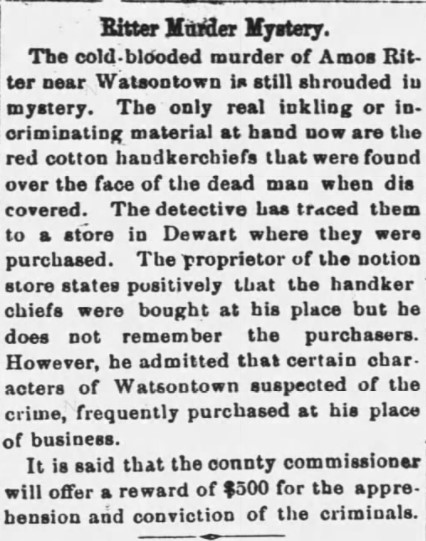
On Tuesday morning, September 7th 1897,  a farmer inspecting his field of rye found a body lying on the ground.  The mans boots had been removed, and were placed between his bare feet. Two red handkerchiefs were placed on his face to cover it, held down by his wool hat. Under the handkerchiefs, there were seven gashes about his head and face.  One nearly separated his ear, and one laid the cheek open.  "the other gashes were spread about the top of the head, and ran from left to right, showing that the assassin had stood over his victim and chopped him as he lay."On one arm there were five wounds thought to be be from the victims attempt to defend himself.  The murderer had evidently left the field walking backwards, scraping dirt over each of his footprints as he went.  The marks of a finger were distinctly seen in the dirt.

The spot where Ritter was murdered, in a recently dug potato field, was within sight of the grave of Nelson E. Wade, who 25 years earlier murdered Mr & Mrs John McBride. Wade was hung in Williamsport, and his body was buried in the corner of a field near the Amos Ritter home.

 The farmer who found the body was  Mr Jacob Bets, and the man laying dead in his field was his neighbor, who had spent the evening before in the Bets home, having dinner with the family.  

For more than 6 years, rewards were offered, and much speculation was made.  At one time, there were rumors that a confession had even been made. Repeatedly it was asserted that the murderer was certainly a neighbor, and that two women who lived nearby knew more than they were saying.  

But the murder of Amos Ritter was never solved.  

Amos Ritter, Murdered in this field, 1897
A marker stands in a field near Rt 54, north of Watsontown.
GPS Coords - 41.12906, -76.83742

On Monday September 6th, Amos Ritter had purchased bread at Fry's bakery in Watsontown, tobacco in Messingers store, and a small load of phosphate from Rob Mckee, a dealer. When he left town, he had about $15 in his possession. The local papers reported that "he was also known to have had considerable money in his house". 

According to Northumberland's Public Press newspaper, "On the afternoon of September 6th 1897, Amos Ritter aged 70 years, a well to do farmer of Delaware Twp, visited Watsontown and exhibited a large sum of money.  At night fall he started home a foot, early the next morning he was found murdered in a field near his home, and the money gone." (Later estimates placed the amount missing as anywhere from $100 to $600.)

After his shopping trip in Watsontown, Amos had dinner at the home of Jacob Bets, a neighbor.  At 8pm that night, he headed for his own home, "in good spirits".

At 11pm that same evening, both Mr Bets  Mrs. D.N. McWilliams  (wife of the postmaster) heard a muffled cry, and then a shot.  As it had been a holiday week-end, and the roads had been busy with travelers, neither thought too much of the noises at the time.

In 1897, Amos Ritter, age 70, lived on "an old house on a little farm of a few acres close to the public road near Sedan post office". The 1874 map of Northumberland County shows an A. Ritter on a road today known as Crawford Road, near where 54 runs today.  Next door was Valentine Ritter, Amos's father.  

Amos Ritter was born the son of Vaentined & Catherine (Lohr) Ritter.  He married Martha Jane Young, and they had 6 children: Clarissa (Clara) Ritter Kling, William A. Ritter, Katura W. Ritter Crawford, Mary Elisabeth Ritter Beaver, Alphineus Ritter, and Lillie A. Ritter McGafferty. Although he was still married in 1897, him and his wife had been estranged for a number of years, and she resided in Muncy.  His occupation, from 1850 - 1870, was "tailor", and in 1850 he worked in a tailor shop in White Deer.  In newspaper articles about his murder, he was sometimes referred to as a blacksmith, and the census in 1880 listed him as a "laborer". After his murder in September of 1897, Amos Ritter was buried in Muncy Cemetery.

A newspaper sketch, included in an article about the murder

A Clue Found A Week Later

In mid September of 1897, the County Commissioners offered a $200 reward for the arrest of the murderer.  The Columbian, a Bloomsburg newspaper, reported: "Detective Dougherty and a posse of 20 men scoured the country round the home of Amos Ritter, in an effort to find the hatchet which which the old man Ritter was murdered a little over a week ago.  

More than a week  after the murder, a paper in which Ritter had wrapped his coins was found at the spot where he had been murdered. As the area had been searched thoroughly in September, and it was obvious the paper had not been exposed to rain or dew, it was certain the murderer had returned to the scene of the crime.

The Columbian reported "The arrest, if made as suspicion now directs, will reveal not only some very startling fact, but, if conviction follows, will expose one of the most deceitful and treacherous crimes ever committed in Central Pennsylvania."

However, no arrest was ever made.   

Speculation & Theories

"Speculation is rife as to the identity of the aged recluses murderer.  There is a well authenticated report out that the authorities suspect a woman, but the deed was so brutal that is a woman was guilty of it she must have been actuated by a cruel mania.  A shrewd trick of the assassin was the covering of his or her tracks that led from the spot where the old man's body lay."

In late March of  1900,  local papers theorized that Ritter may have been a victim of the recently convicted murderer William Hummel. Hummel was known to have been in the vicinity of "the old blacksmiths home" the night that Ritter was killed.  Hummel, a rag peddlar, had left the home he was staying at early in the evening, and he did not return until Midnight.  When asked where he had been, he replied "Oh, I was just calling".

Hummel however, adamantly denied any involvement, even as he faced the gallows for murdering his wife and children.  "I can only die once" he said, "so what need I be afraid of it?  If I did it, I would say so, but I didn't."

In July of 1900, half a dozen local citizens declared their willingness to subscribe to a fund to pay for a detective to be brought in on the Ritter case.  According to the Columbian, a newspaper in Bloomsburg, " Within the last week or two there has been developments that are reported to point quite conclusively to several parties with certain proof believed to be indisputable.  The people feel that the brutal murder of the old man, now three years ago, should be avenged."

By August of that year, the Northumberland County Commissioners had upped the reward to $1,000 for the arrest and conviction of the murderer. 

Three years later, six years after the murder, no one had been arrested for the crime.  Rumors flew through local communities in July 1903 that a man had confessed. "The report in circulation" was that the neighbor of the dead man was on his death bed and had made a confession.  The story, given in detail, included the details about buying a cow and paying for it with dime and small silver pieces taken from the Ritter home.  Although the story "tallied so well with the rumors that have been in circulation among the old man's neighbors", the confession could not be proven.

=====================
Find More Local Histories & Stories Here:

==================
READ MORE
==================

Although not a direct line ancestor, Amos Ritter, the son of Valentine & Catharine (Lohr) Ritter, was the cousin of Zebedee Ritter.  Amos & Zebedee's parents were brothers, both sons of Martin & Barbara (Fredericks) Ritter.  Zebedee Ritter was Dan's 3rd Great Grandfather.


1880 Census
Name: Amos Ritter
Age: 50
Birth Date: Abt 1830
Birthplace: Pennsylvania
Home in 1880: Delaware, Northumberland, Pennsylvania, USA
Dwelling Number: 198
Race: White
Gender: Male
Relation to Head of House: Self (Head)
Marital status: Married
Spouse's Name: Martha J. Ritter
Father's Birthplace: Pennsylvania
Mother's Birthplace: Pennsylvania
Occupation: Laborer
Neighbors: View others on page
Household Members:
Name Age
Amos Ritter 50
Martha J. Ritter 46
Clara Ritter 23
Wm. A. Ritter 19
Katena Ritter 14
Mary E. Ritter 10
Alvenus Ritter 8
Lillie A. Ritter 5


====================
The Amos Ritter Marker is visible from the road, please respect private property!