James Bressler of the Lycoming County Historical Society, on May 16, 1962, interviewed Mr. Antes who had witnessed lumbering on the Susquehanna River from 1884 to 1894. The recorded interview is printed here. Mr. Antes was president of the Historical Society from 1957 to 1959.
Mr. B. Mr. Antes, we want to ask some questions and get some first hand information about some of your experiences. Gibson, first of all, you lived on the river, didn't you?
Mr. A. I really was born on the river bank. You could stand on our front porch and throw a stone into the river, and I lived there until I was fourteen years of age.
Mr. B. Well now, I'm trying to picture in my mind just where this was. It was somewhere in the vicinity of Linden, wasn't it?
Mr. A. It was on the opposite side of the river from Linden, about two miles from the village of Nisbet, on the next to the last farm up the valley.
Mr. B. Who lives there now; do you remember?
Mr. A. The house in which I was born has been torn down for at least 60 or 65 years, but the farm is now owned by the Stewarts.
They owned the farm next to the William Gibson farm on which I was born, and where I got my name. William Gibson was an uncle of my mother. We were living on his farm. My parents had come down from Centre County in the spring of 1880.
Mr. B. Now the other thing I remember, in historical records we had a Colonel Antes who was quite famous and who built Antes Fort and who had a mill up there, you know. Where was it? Just beyond Jersey Shore? You are a direct descendant somehow of these Anteses.
Sketch of Col John Henry Antes
Mr. A. Colonel John Henry Antes is my great, great, great grandfather.
Mr. B. This is a long time ago, back in the seventeen hundreds!
Mr. A. He was born in 1736. My grandfather was born in 1810.
Gravestone of Lieut. Col. John Henry Antes 1736-1820
Mr. B. Getting down to the lumbering days - of course, as I understand it, the lumbering actually began on a large scale here in the West Branch Valley and Lycoming County around 1850 somewhere, wasn't it?
Mr. A. Around 1850, or maybe '54 - '55, or it might have been a little earlier than that when just a few logs were floated down and caught by men in boats.
Mr. B. I see. Now, when we talk of rafting on the river - the rafting wasn't done in the later time so much, was it? Was it done in your time? Did you see the rafts come down the river?
Mr. A. Oh yes. I saw many rafts come down the river.
Mr. B. Now, right there. There's something I'd like to know more about. When you talk about a raft, how big was this raft? What was it constructed of?
Mr. A. These rafts were, I think, about 27 feet wide. That was the width they were so they could go through the chute at the dam.
They could be anywhere from 150 feet to 250 feet long.
Mr. B. Now the chute at the dam - we want to clarify that. We'll come back to that a little later. You're talking about a splash dam?
Williamsport Dam, 1911
Mr. A. No, no. I'm talking about the regular dam as the dam is over there at the foot of Hepburn Street today.
Mr. B. Oh. What was the purpose of that width? You mean there was a spillway or what, that they went over?
Mr. A. That was an opening in the end of the dam where the water could go through without having to go over the dam.
Mr. B. I see.
Mr. A. Whether that was put in on purpose so that the rafts could be sent through it or not, I couldn't answer that.
Mr. B. Well, now, this dam here at Williamsport, was that put in for the purpose of damming up the water for logging?
Mr. A. I'm not sure about that. I understand the first dam was built of just brush and stones, and then about 1858, I think somewhere in that vicinity, a few years more or less, a permanent dam was built such as there is there today.
Mr. B. Oh, that long?
Mr. A. Yes.
Mr. B. Now these rafts were made of trees or logs, weren't they?
They were log rafts?
Mr. A. They were logs.
Mr. B. Now, just for description, since no one in our time has ever seen one except this so called "Last Raft" that met its end down there at Muncy. These rafts were constructed where?
Mr. A. Well, I would say as far up the river as there was room to raft them, up above Clearfield. Maybe clear up to Cherry Tree. I'm not sure.
Mr. B. And they came down here all the way as a raft?
Mr. A. That's right.
Mr. B. All right, now if you bring something that large down the river - and I assume that was much cheaper and better transportation than bringing the logs down by rail - you have to have a method of steering.
Mr. A. That's right.
Mr. B. Well, how did they manage them?
Mr. A. They were steered by what they call an oar or sweep. One on each end. The ordinary raft, I think, had two on each end. And sometimes one man, sometimes two or three, would be operating that sweep to keep the raft in its channel.
Mr. B. I'd think that would take a little skill, wouldn't it?
Mr. A. That took skill and especially it took skill if it was windy or if the river was a little high. And it was hard sometimes in a high wind to keep a raft from being blown in against the shore. Sometimes they had to tie up a raft because they couldn't control it. And the tying up of a raft was a skilled job that really took men, and I mean men, to do that job.
Mr. B. What do you call those people who ran rafts?
Mr. A. They were just called raftsmen.
Mr. B. They were the raftsmen?
Mr. A. They were the raftsmen.
Mr. B. Now, when you start out with a raft you don't bring it down in a day. How did they manage at night?
Mr. A. They usually tied up the raft at night, because there wasn't a good possibility of keeping the raft in its right place by running it at night.
Mr. B. Did they have any kind of a cabin or anything on there - a kind of a house or hut on the raft?
Mr. A. Yes, a great many of the rafts had cabins on the top that the men slept in and lived in. Then there were some rafts that didn't do that, some that would tie up at night and stay at some farmhouse along the river.
Mr. B. When a raft was put together was there any trick to it? You had different kinds of logs. Were they built of one kind only?
Mr. A. The logs that came down in rafts were not regular logs like were used generally for timber. They were larger pieces of timber or larger logs used for some special case. Many of the rafts were made of large timbers that were used for spars on ships.
Mr. B. The ordinary saw log as we know it, the thing that made Williamsport the capital for lumber as we knew it, they were not ordinarily brought down in rafts?
Mr. A. The ordinary lumber log was never in a raft. They were floated free.
Mr. B. They were special cases.
Mr. A. Yes, they were floated free.
Mr. B. Wasn't this river valley famous for these kinds of trees?
Mr. A. Yes, it was. Up in the western part of our state from Cherry Tree on down this way for a long way. As I understand it, there were pine trees that could hardly be duplicated any place in the country.
Mr. B. That's what we've heard. Now — that is one form of log being brought down the river. Now we get to the log drive. We've heard a lot about log drives, and that's a term that not everyone would understand if they never saw it. Just what was a log drive?

Mr. A. Well, a log drive— in winter the logs were cut in the woods and brought to the edge of the stream so that when spring rains came and the stream rose, then the logs could be floated. As soon as it was possible to float those logs in the spring, then men started to put them in the river and keep them moving down the river, and that was called a log drive. These men were called drivers. They were log drivers, and as I've said before about the men, they were real men, because those men would go into the water, ice cold water possibly in March, as soon as the floods came, and would be in ice cold water possibly up to their waists, maybe a whole day. And they claim that those men slept in the clothes that they wore. They wore heavy woolen underclothes, and they lay down and slept in them. Some of them wouldn't have their clothes off for maybe a week.
Mr. B. Now, they didn't follow those logs all the way down the river, did they?
Mr. A. They followed the logs as much as was necessary to keep them from being stranded on the bank along the river.
Mr. B. Oh, yes. Now of course you had different lumbering outfits up there in the mountains wherever they came from. You had different lumbering outfits putting the logs in. In other words, it was much like the cattle country out west. You'd have to have the logs marked somehow so that each company could identify them. How was this thing done?
Mr. A. Each company had a brand that they put on each end of the logs that belonged to them. Those logs were branded in the woods before they were put into the water. They had a brand on each end to mark the mill or company to which that log belonged.
Mr. B. Now let's say a company down here in Williamsport received logs, did it also have a contingent of men up in the woods who did the cutting?
Mr. A. They would have men in the woods who cut the logs for them, cut their timber, and got them into the river and floated them down to the boom.
Mr. B. Can you remember some of the names of the large logging outfits in Williamsport - let's say around the turn of the century?
Mr. A. Brown, Clarke, and Howe. The Emery Lumber Company was one big company. The names just slip me now, but each company had a mill of its own.
Mr. B. Well, I think we have some of the log books where they marked down the log footage and so forth of some of these companies. I believe we can get some of these at the Museum.
Mr. A. Yes, we can easily get those of many of the companies.
Mr. B. The log drive originated in the mountains. You say it started in the spring when you had high enough water to give the logs a push. I suppose they came from quite a ways up in the mountains.
Some of these streams were high then. Now here's the interesting thing about Williamsport about which I have wondered so long. How in the world do you stop the logs here? And how did you get them to the mill and out of the river? The river was a pretty wicked thing then, wasn't it?
Mr. A. Yes, it was, at that time of year, when the waters were high, when the snow was melting off the mountains, and they called it the spring freshets.
Mr. B. How did they stop them down here?
Mr. A. Well, before the boom was built, those logs came down not very many at a time because it wasn't possible to take care of very many of them at a time. They had to come rather singly because men in boats here in the vicinity of Williamsport would get hold of those logs and take them ashore. For logs coming in at night, they built fires on the shore and built fires on flatboats out in the river so that men could see a log coming and get hold of it. Many logs were lost at night too.
Mr. B. They were brought in and they were stopped at the boom.
Just exactly what was a boom?
Mr. A. These logs that I'm talking about came in before the boom.
There was no boom to catch them.
Mr. B. Yes, well, afterwards.
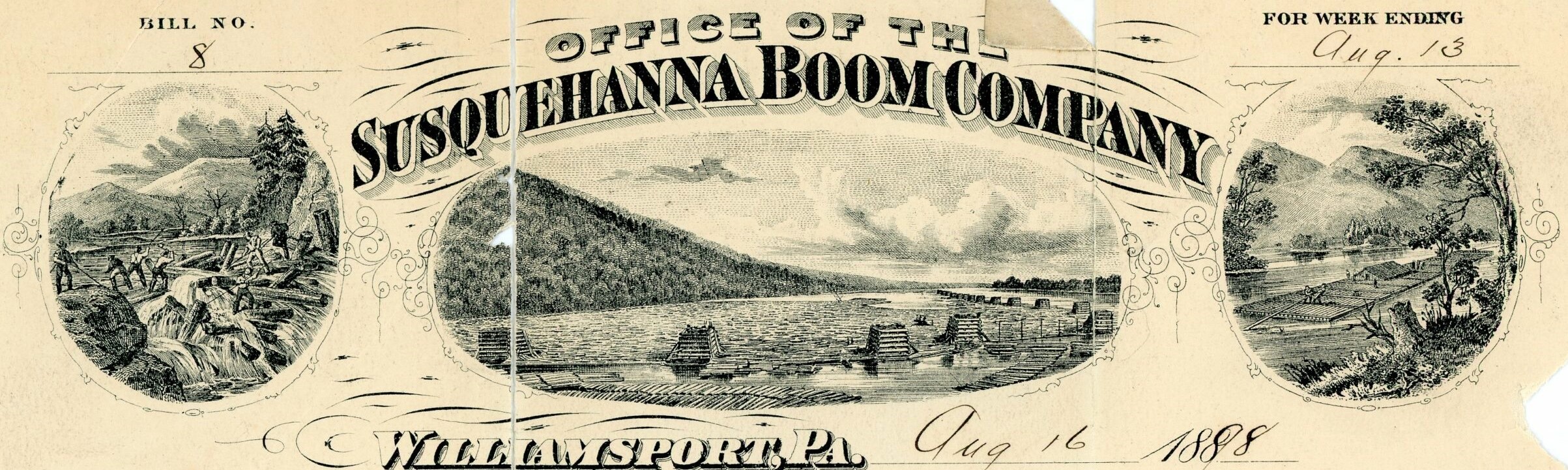
Mr. A. That's right, the boom was a series of piers built near the middle of the river, and they were a pile of stones in the river that would come up possibly near the water level ordinarily. Then on top of that was built what was called a crib. That crib was built of heavy timbers that were made to crisscross in such a way that those piers then were filled with stones which held them on this pile of stones that was already in the river. Those piers were 175 feet apart, and then to complete the boom, what we called boom sticks were strung from pier to pier.
Mr. B. Were these boom sticks floating logs?
Mr. A. The boom sticks were big timbers that they used to connect the piers together, and the logs came down inside of these piers and these boom sticks, and were held there by the booms sticks that were 'run' from one pier to another.
Mr. B. How high off the water was a boom stick?
Mr. A. A boom stick? A boom stick floated.
Mr. B. That's what I was wondering about.
Mr. A. The boom stick floated at the water level.
Mr. B. It must have had a connector or chain on each end of it.
Mr. A. That's right. It had big clevises that held the boom sticks together, and they were heavy irons. As a rule, I think, that iron would probably be from 3/4 to an inch thick. They were very heavy, on chains that would be at least an inch of iron link, made out of iron at least an inch thick.
Mr. B. And in the spring you'd have a little trouble there, wouldn't you, if you had high water? Did these boom sticks float up and down with the water level?
Mr. A. Oh, yes, the boom sticks were always with the water level.
Mr. B. We talked about some of the descriptions of these log rafts and log drives, and we learned what the picture was around Williamsport. I'd like to ask you, Mr. Antes, some of the interesting things you have observed while living in the vicinity of the river and probably roaming among these lumbering people and these rafts and logs as they came down the river. What are some of the things that you remember in your early childhood about this, any particular incident that sticks out in your mind.

Mr. A. Well, I wasn't too old. I remember I was in my ninth year when the flood of 1889 came, and the water was three feet deep in our house. I remember that before the time came that the water had reached its height and we knew it was coming into our house, we all went up to a neighboring farmhouse, with a large bank barn, and there we spent our time for the next two or three days until the water receded. We could have stayed in the brick house that was up there when the water was just eight or nine inches from coming onto the first floor, but there was a large jam of logs right above the house among some trees, and we were afraid, or our parents were afraid, that there might be a possibility that if the river came higher that log jam might break and ruin the house. So we went into the barn, and in that barn we lived for the next couple of days and nights until the water had gone down enough that we could go back into the house and back into our own home. This house, that I was born in, was on the river bank as I have said.
Mr. B. Now I can see where that would really thrill you if you had a bunch of logs threatening to come down and possibly take away your house.
What happened down here in Williamsport at that time? As I recall the 1889 flood happened sometime in early summer, didn't it?
Mr. A. June.
Mr. B. What happened at Williamsport at that time where the lumber boom was, the actual boom?
Mr. A. Well, the boom was broken at that time and all the logs in it (approximately 300,000 feet of lumber were in the boom at that time) that all escaped.
Mr. B. 300,000 feet of it!
Logs on the island at Milton, after the 1889 Flood
Mr. A. 300,000 feet of lumber was about the capacity of the boom, and the boom was filled at the time of the 1889 flood. Those logs went down the river, some of them out into the Atlantic Ocean. After the flood was over the men who owned those logs advertised for them to be collected. They were gathered at some points, and in some of those places, mills were set up to saw what logs might have been salvaged from the runaway. I imagine it was a big loss to the lumber people because many of those logs would never be recaptured, some of them going out through the Chesapeake Bay and into the Atlantic.
Mr. B. I think Meginnes gives a description of some of the aspects of that 1889 flood. Meginnes and some other historian from Muncy, Gernerd, I believe. I read his description of that '89 flood. Apparently some of these logs that broke loose from the boom took away bridges and everything in their path.
Mr. A. I think that both the Market and the Maynard Street bridges were taken off. That part I do not know too much of, since I was only in my ninth year and didn't know too much about it.
I do know one thing that came to us after the flood. We didn't have very much to go on, and from a relief association that was set up at that time we got some shoes, I remember, and other things in the way of clothing. And I remember that my mother had $25 in her dress pocket. Twenty of it was in silver, and five dollars was a five dollar gold piece. When my father picked her up to carry her to this house above our home, she upset the pocket, and all the money went down into the water. She observed where that place was by noticing some trees and so forth, and after the flood was over, the $20 in silver was found intact, and about two years after that when they were plowing that field, they were digging around in the vicinity of where they thought it was and found the five dollar gold piece. That $25 was about all the money we had at that time.
Mr. B. I imagine that it was pretty hard on the animals, too, anything that got caught in the water.
Mr. A. Yes, a lot of animals lost their lives. The animals that we had were all taken into this barn where I told you we were. It was a big bank barn, and it was above the water. The two families and all the stock that each owned were in that barn.
Mr. B. Now, another thing that it's almost impossible for us in 1962 to visualize— just what it looked like around Williamsport in the vicinity of the river during the lumbering days. It certainly couldn't have been built up as it is now, and it couldn't have been as noisy or as smoky here.
Mr. A No, back in 1889, Williamsport was very much different from what it is today. My impression of the city at that time is not very vivid because I wasn't around Williamsport very much. Eight or nine miles away from Williamsport with nothing but horse and wagon to get around, we didn't get to Williamsport very often.
Although, my father raised potatoes, and in the fall he'd bring the potatoes to Williamsport and peddle them out among the people. I recall being with him one time when potatoes were selling at the enormous price of 15 cents a bushel, and someone said, "I'll give you 10 cents a bushel for them." My father said, "No, if I can't get 15 cents for them, you can't have them." That was a time when it was hard work to get potatoes, and a bushel of potatoes meant quite a bit to the farmer who raised them. We didn't have very much to go on.
Mr. B. Yes, I think that was the case everywhere. Now, getting back to some aspects of lumbering. It might be interesting for us to know what kind of trees were the predominant trees of this day.
Mr. A. Mostly it was pine and hemlock, although, in the beginning a hemlock tree was not considered to be worth very much after you took the bark off it, which was used for the tanning process of leather.
Mr. B. You mean to tell me that the debarking of the hemlock tree was a common thing then?
Mr. A. Yes, they took the bark off the hemlock tree, and it was used in the tanneries to tan leather. And for a long time those hemlock trees were just left to lie in the woods and rot. Hemlock was not considered a usable wood as it is today.
Mr. B. Now, what other trees were mostly involved in these drives? Aside from pine and hemlock.
Mr. A. Aside from pine and hemlock, oak would be as much a one as I could say anything about.
Mr. B. Was that white oak?
Mr. A. Yes, mostly white oak and red oak.
Mr. B. They must have been quite big if they were the original trees.
Mr. A. Yes, and another thing, in the floating of these trees, if oak lumber was to be put in a raft, they had to have fairly good-sized pine logs in parts of the raft or the oak logs would float almost at the water level. They would be under the water, heavy enough, that they would be at about water level, and they would use the pine logs to hold them up.
Mr. B. Well, the oak log, if it were at all water-logged or heavy wouldn't float, I imagine, at all.
Mr. A. They'd float just level with the water.
Mr. B. You mentioned just a bit ago about the debarking of the hemlock tree and using the bark for the tanning. Just where and how was that done?
Mr. A. That was done in the woods. That's where the logs were cut.
And when they were cut down, they'd cut around the bark, cut a ring around the tree, cut the bark just into the wood. Those pieces, I think, would be approximately two feet apart, those rings. Then they used what was called a "spud" which was an instrument made for getting the bark off the wood. That was done at the time of the year when the bark was practically loose from the tree and the bark would come off very easily - when there was lots of sap between the bark and the wood. That's what they called barking, and the men who did it were called bark peelers.
Mr. B. Have you any idea what kind of wages people in the woods received in those days? What did the average workman receive?
Mr. A. I think the average workman worked from early morning to late at night for from $1.00 to $1.50 a day. Even the men on the boom worked for a $1.50 a day.
Mr. B. Of course, everything you bought cost comparatively less.
Mr. A. That's right. Everything was in comparison with that kind of wage. Those men, as a rule, worked possibly 10 to 12 hours a day.
Mr. B. Getting back to some of the interesting things that you saw in the early days here around Williamsport. Did you at any time have anything to do with or did you mix or mingle with these log men as they came down the river? What kind of people were they?
What interesting experiences did you have with them?
Mr. A. Well, we lived where we could look up the river for approximately a mile and a half and see a raft coming, what we called, "around the bend." When we'd see those rafts coming we'd go into the house and maybe get a pitcher of cider or a dozen eggs or a loaf of bread or maybe some apples, and we'd get into our boat and row up the river a little ways. When the raft came along we'd take those out and sell them to the raftsmen. That was always quite an experience for us to come in touch with these men.
Then many of the men would have a raft tied up near our home when they'd get into trouble and had to tie up. We've had them in the house overnight. We've seen them snubbing the raft, what they called "snubbing the raft", to get them stopped so that they wouldn't get into trouble because of the wind or because the water was a little too high for them to guide them right.
Another thing I remember that we as youngsters did as we spent quite a lot of time along the river. We'd gather up pieces of log and driftwood and use that for firewood for our home, and we got kind of skillful ourselves on running the logs. Lots of time we'd get hold of the calks which the rivermen had in their shoes - two courses of calks around the sole of the shoe and also on the heel of the shoe which kept the men from slipping off the logs. We'd get hold of them sometimes and put them on our own shoes. We got so we could ride the logs pretty well ourselves. Of course, sometimes we were riding alongside the logs instead of on top, but we soon got out again and on top. I've seen the river full enough of logs at one time floating, that if you were skillful enough you could go clear across without getting wet because the river was full of floating logs.
Mr. B. That was tremendous board footage. It's almost inconceiveable. The river was about the same width as it is now, or entirely so.
Mr. A. Yes.
Mr. B. Now, there is something else I was wondering about. We can picture these men working the logs. Are there any special tools that they used for guiding or working the logs and maneuvering them in the water?

Mr. A. Well, in the handling of the logs you used a cant hook and a pike pole. Some people call a cant hook a peavey. Whatever it was, it was a piece of wood very skillfully made with a hook on it and a pike. You could put it over the log, and then the hook would catch the log so you could turn it. Several of these you can easily see in the Museum. We have them there. That was called a cant hook. Then they maneuvered the logs by using a pike pole. That maybe would be 10, 12, or 14 feet long. That was a long piece of wood made and rounded and piked. That pike on the end was quite sharp. That was made on the order of a screw, and you could throw it into a log and it would take hold, and when you wanted it to let loose, and sometimes you'd have to have it let loose in a hurry or you might go into the river with it, you'd just give it a twist backward which would, you might say, unscrew it out of the log.
Mr. B It sounds like a skillful occupation.
Mr. A It was! It might have been considered rather crude, but men had to be very skilled to do the things and use the tools that were used along the logs. Especially with this crew on the log drive. Sometimes they would form what was called a logjam. Something would stop the logs and cause them to pile up in the stream. This was extremely dangerous work and required great skill to find the key log that caused the jam and to pry it loose so the logs could move again.


.jpeg)

.jpg)
.jpg)


.jpg)

.jpg)
.jpg)


.jpg)




.jpg)


.jpg)

.jpg)

.jpg)


.jpg)
.jpg)
.jpg)

.jpg)


.jpg)

.jpg)


.jpg)


