Showing posts with label Mifflinburg. Show all posts

Saturday, April 12, 2025

Red Bank School, Mifflinburg Pa

 
805 Red Bank Road, Mifflinburg, PA

Originally a wood plank school built at the northwest corner of Forest Hill and Red Bank Roads.  


The building was replaced with a brick building in 1886, on land owned by the Edlemans, a little to the east of the original building. 

 The old wooden school was move to the new location, and used as a coal shed for the new school.  it was razed in the 1990s.


In 1953,  West Buffalo Township purchased the building for $1.  They used it as a township building until 1988.


The Union County Historical Society, in partnership with the West Buffalo Twp Supervisors, restored the school house to be used as a museum.

==============
CLASS PHOTOS

1917

1926-27

========================

Sunday, April 6, 2025

The Mifflinburg Academy


The Mifflinburg Academy 

 Located on the corner of 6th and Green Streets, no longer stands.  Today the Mifflinburg Buggy Museum Visitors Center stands at this location.  The cupola from the top of the school is preserved in front of the visitors center.

The cupola from the Mifflinburg Academy, in front of the Mifflinburg Buggy Museum Visitors Center

According to a 1963 article, the Mifflinburg Academy began "in the Franklin School on the North Side of Market Street between Third & Fourth Streets" - Note that that location was the Franklin School, not the building shown here.  The building shown here, the Academy building, was located  on the northeast side of Green Street between 5th and 6th, where the Buggy Museum is today.

Rivaly between Mifflinburg and Lewisburg began in an 1827 debate.


1837


The Mifflinburg Academy "ceased to exist" in 1868.  On September 3 1894 it became the Grammar School.  The first floor of the school was used for "common school purposes" and the second story contained the hall of the Grand Army Of the Republic post. [according in a 1963 newspaper article]

A sign inside the Cupola reads:

"The architectural structure is the cupola from the Mifflinburg Academy.  The two-story brick building was demolished in the 1970s.  the first school in Mifflinburg was the German School, located at Fifth and Green Streets.  Classes were taught in German.  The Franklin School for English speaking children was located on Market street.  These two schools were subscription schools, which meant parents paid the teacher directly.  In response to the Public School Act of 1838, the Mifflinburg Academy was built.  As a public school, the Academy was supported by taxes.  It's aim was to teach the classics and encourage students to achieve higher learning.  The Mifflinburg Academy was closed as a school when the Mifflinburg High School was built in 1876.  The building was used to provide temporary housing for men looking for work during the Great Depression (1929-1941).  When the high school was overcrowded in the 1940s, the building was re-opened as an elementary school"

This page from the 1928 Mifflinburg Yearbook, The Nautilus, appears to contradict the above information - it lists some of the students who attended the Old Academy in 1916-1920.


======================

READ MORE
=====================
1924

1925

1925

High School Auditorium, 1927

Mifflinburg High school, 1928


"It is to the credit of Mifflinburg that she has never been behind her sister villages in the promotion of education The same day, April 14, 1827, the village was incorporated a Borough, an act was passed establishing an Academy here. Among the trustees named, of Mifflinburg, were Henry Yearick, Jacob Maize, John Foster and Michael Roush. Rev. Nathaniel Todd, a Presbyterian minister, was the first teacher. He was succeeded in 1839 by James M'Clune whose fame as a teacher spread over the State. Then came Prof. Henry. G. M'Guire, who was followed by the much lamented Aaron C. Fisher. These great teachers have all taken their departure to the other world, but their memory is still cherished by their students many in prominent positions, far and wide over this and other States.

The influence of the Mifflinburg Academy will never be fully reckoned until the judgment book shall be opened on the last day of final reckoning." - 1892 article about Mifflinburg's Centennial

Some early history of the Academies in Lewisburg and Mifflinburg


Wednesday, March 19, 2025

The Grave Of Pvt. Etzweiler 1780

This solitary grave sits at the edge of a farmers field along Brouse Road in Mifflinburg

The stone reads:

GEORGE ETZWEILER
who as killed by the 
INDIANS
May 26th 1780
At Jacob Grosclung Mill
Near Brush Valley Narrows
in what is now Buffaloe
Township Union County

Erected by G. Alfred Schoch
Middleburg, September 10 1888

In 1939, the Selinsgrove Times Tribune ran a column that nicely encapsulates the story, as it is recorded in a number of history books.  It does not, however, explain why Schoch placed the grave marker 100 years after the event. 
===================
Historic Pilgrimage 
As recounted in the Selinsgrove Times Tribune, 1939

Frederic Antes Godcharles, historian, of Milton, visited Yesteryear last week, told a story of Indian activities in and around New Berlin, that have given interest to another of those historic pilgrimages in which some of us take such delight. 

Map Of the Brush Valley Narrows - The Heberling Mill, Under the S, is the location of the French Jacob Mill

At the end of Brush Valley Narrows, Union county, about one-half mile southeast of the Forest House is the location of what was known as French Jacob's Mill. The land has long been in the possession of the Wohlheiter family. There in the spring of 1780 occurred a massacre known in history as the Massacre of French Jacob's Mill. The mill was built in 1776 by Jacob Groshong, or "French Jacob," as he was called by his neighbors. Groshong's nickname, "French Jacob" is still preserved in that section in connection with a large spring a short distance above the Forest House. In 1787 he was assessed in his nickname instead of his proper name. 

 Marker Located at: N 40° 58.889 W 077° 03.960
Reads:
"Near this spot JACOB GROZING erected a grist mill in 1776, which was used as a place of refuge by the settlers during the Indian troubles, here on May 16 1780.  A patrol of Revolutionary Soldiers was attacked by a band of Delaware Indians.  The dour following men were killed:
John Forrester Jr
George Etzweiler
James Chambers
Samul McLoughlin"

On May 16, 1780, a patrol of Continental soldiers was on duty as a garrison at the mill, and was attacked by a party of Indians. Four of the garrison were killed and several wounded. Those killed were John Foster, James Chambers, George Etzweiler, and Samuel McLaughlin.

The story is that the soldiers were swimming in the mill race, having just returned from a patrol of the neighborhood and were confident no Indians were in that neighborhood. Christian Shively, who lived near the mill, heard the firing while threshing grain in his field. He immediately hid his wife and two small children near the creek. He then rolled some logs into Penn's Creek and tied them to the raft. In this way they floated down the stream to Beatty's, where New BerIin is now located.

In the Annals of Buffalo Valley, Philip Pontius relates that his father also heard the signal, unhitched his horse and made a circuit thru the woods, gun in hand, to the mill. He related how one man named William Fisher narrowly escaped. He was running to the mill during the attack. Just as he reached the door his foot slipped on a wet board and he fell into the door. The bullet intended for him struck into the building on a line where his head would have been had he not fallen.

"John Foster was an uncle of Captain John Foster, of Mifflinburg, and a brother of the old Major Thomas Foster. James Chambers was the son of Robert Chambers. "George Etzweiler, Junior, left a widow, Mary. George Etzweiler, a son of the one killed, kept hotel at McKee's Half Falls, as late as 1812. William Fisher was the grandfather of James Crossgrove and Sheriff John Crossgrove, and resided in Limestone, where James Crossgrove lately resided.

William Gill told me he heard old Mrs. Overmeter say that the e people who were killed, were brought over to the place adjoining Philip Seebold's residence, above New Berlin, and were buried in the old graveyard on the bluff at the creek, where Dry Run comes in, nearly opposite where Tuscarpa Run enters Penn's Creek, on the Snyder county side. (Philip Seebold said, in 1872, that George Etzweiler was buried on Jacob Cook's place, now Peter Slear's, in Limestone township.) Here old John Trester and the first settlers were buried. The graveyard, probably the oldest in the county, was not used after 1791, when the people commenced burying in New Berlin. It belonged to Thomas Barber, who was killed in 1792, by the timbers of an old barn falling on him...."


=====================
READ MORE
==================
B is the French Jacob Mill Marker
A is the Etzweiler Grave Marker

==================================
Hon. G. Alfred Schoch 1843-1917, Middleburg Pa
He was president of the First National bank, and President of the Board of Mangers of the Main Shoe Company. His death certificate listed his occupation as "capitalist"
=========================

French Jacob by Bruce Teeple

One joy you get from reading historical materials is in finding the unique stories that breathe life back into long-dead characters. Enough bizarre tales about “French Jacob” Groshong fortunately survive to help us understand how one person made decisions on the Susquehanna frontier. 

We usually see French Jacob’s name associated with the 1780 Native attack at his mill north of Mifflinburg. Earlier life events, however, gave him a wide spread reputation for more than just grinding grain and sawing timbers.

 While the family name was originally “Grosjean” (or “Big John”), pronunciation along the borderlands of France and Germany follows its own bilingual logic. It was here that French Jacob was born in 1725. At the age of 26, he arrived in Philadelphia, bought several hundred acres in the Millersburg area two years later, and erected a mill. 

Stone milling is more than an “art, trade and mystery.” Millers not only had to adjust the milling process to temperature and humidity fluctuations; they needed excellent political and social skills, for the mill was the center of community life. Farmers went to mills to have their grains ground into flour or distilled into the more profitable whiskey. Waiting in line gave them the chance to get the news, discuss and vote on the issues, or buy lumber if the miller also operated a sawmill. Success required a trustworthy, engaging personality able to handle competition effectively.

 It didn’t take long for French Jacob to seek a commercial advantage by demonstrating his supernatural powers. A wave of his hand was said to control snakes and bears. His “magic words” reportedly cured disease and turned unruly children into wild animals. When a forest fire raced down Berry Mountain (near Millersburg), French Jacob drew a line in the dirt and reassured his neighbors that the fire would go no farther. Any attempts to fight it, he warned, would break the spell. Another story, about French Jacob’s secret silver mine, swirled around the valley. Neighbors swore that whenever he needed money, they saw him wait for the right phase of the moon, utter an incantation, walk into the mountain, and then return with a silver bar. 

On the eve of the American Revolution, French Jacob moved his milling operations from Millersburg, 50 miles north and west to Buffalo Township. He is listed among the inhabitants of Buffalo Township in April 1780: “Groshong, Jacob, grist-mill.” Losing a lawsuit over the site’s ownership, though, led him to relocate his mill down the road in 1783-84. He added a sawmill in 1785.

 But people no longer fell for the old gimmicks. Shrewdness and efficiency were replacing monopoly and sorcery as sustainable marketing strategies. Increasing populations, more competition and promises of opportunity always forced French Jacob farther west

. Records indicate that French Jacob Groshong worked in Centre County for a few years in the early 1790s. His name disappears from the Buffalo Township taxables list and his mill is assessed to Enoch Thomas in 1794. After that, the stories become less clear. Conflicting accounts say he died either in Kentucky in 1800 or in Missouri in 1826. As 19th century historian William Egle summed up this unusual life: "He knew whatever was to be known, and much more than he knew he'd own.”


Wednesday, November 6, 2024

Stories From The Cemetery - Mifflinburg Pa

Stories From The Cemetery - Mifflinburg, Pa

When wandering through the cemeteries, often for my own genealogical interests, but sometimes for find a grave photo requests, or geocaches, I cannot help but wonder about the stories behind the stones.  Many of the stones are works of art, and some day I would love to learn more about the stone carvers in our area.  But for now, as I come across a marker that catches my attention for any reason - sometimes because I remember the name from some prior research, often just because I was intrigued by the stones design - I take photos, and add notes as time allows.  I have folders full of photos, and there is no rhyme nor reason to which I research on any given week. These are simply some of the stories behind the stones
=========================
 Old Mifflinburg Cemetery, also known as Fairview Cemetery & Woodlawn Cemetery, is located on the west side of Rt. 304. The cemetery was established no later than 1817 but was likely utilized for about 20 years prior to that.  Several mausoleums in this section are built into the hill, like small caves.

View from the hill in the cemetery, November 2024.
The old Elias Church is the yellow building to the right.

There are a great number of Revolutionary War soldiers buried in this section.  Many of the stone are no longer readable.
 
Standing behind the front row of mausoleums

View from the mausoleums on the hill

=============
The Mausoleums


Dr. Jacob Henry Hassenplug
1827-1899

DR. HASSENPLUG DEAD A Native of Union County and Highly Successful Physician Dr. J. H. Hassenplug, one of Philadelphia's oldest and most honored physicians, died yesterday afternoon at his residence, 611 North h Sixteenth street, of pneumonia, after an illness of only one week.

Dr. Hassenplug was born in Miffinburg, Union county, Pa., November 25, 1827, and received his early education there, supplementing it with medical studies in this city and elsewhere. He graduated from Jefferson Medical College in 1850, when he began practicing his profession in his native town. Dr. Hassenplug served in the Civil War for three years as surgeon in the 109th Pennsylvania Volunteers, and for the last thirty-Ave years was a resident of Philadelphia.

Three sons, all physicians, and three daughters survive him. For many years he was identified with the Masonic fraternity and was a member of Potter Lodge, No. 441. He was also one of the oldest members of Trinity M. E. Church. Interment will be in the family vault, Mifflinburg, Pa.


 "Death of James  Cardwell at Chester. A Chester dispatch of the 16th inst. says: James E. Cardwell died to-day, aged 52 years, from heart trouble.

For many years he conducted one of the largest furniture stores in this city, and yesterday closed negotiations for the sale of the building for $20,000 to Philadelphia parties, who will open a department store, having decided to retire from business and go South for his health. Mr. Cardwell was a son-in-law of Mr. Wm. B.and Mary Agnes Barber, late of Miffinburg, dec'd, having been joined in marriage with their daughter, Henrietta C., Dec. 26, 1889. After marriage they located in Chester, where he conducted a furniture store very successfully. a He was a fine gentlemany friends there and in this place and vicinity. Appropriate services were held at his late home on Wednesday, being largely attended, and on Thursday the remains arrived in this place, accompanied by his bereaved wife and a number of other relatives and friends, the body being taken to the home of Miss Sarah F. Barber, where, in the afternoon of said day services were held, conducted by Rev. M. H. Calkins, D. D.

The body was placed temporarily in the vault of Mr. H. Strunk in Fairview cemetery.

[James died in 1906.  The year on the mausoleum is 1906 - so it's likely the body was placed "temporarily" while this mausoleum was built?]


One of the mausoleums was broken into on April 26th 1990.
A skull was stolen.  It was later recovered, and placed back in the mausoleum by Terry Willow.

"he was asked to return a skull stolen by a couple of kids from a Mifflinburg mausoleum.  No one else wanted to do it, not even the cemetery's caretakers.  When he did, he caught a glimpse of the skeleton before he placed the skull in it's rightful position.  He didn't bother taking the skull out of the bag it was kept in."  - The Daily Item

==================
More Gutelius Graves

Frederick & Lydia Gutelius

 
Frederick Gutelius
17 Mar 1797
14 Feb 1866

  Although marked as a Revolutionary War grave, Frederick, born in 1797, served in the war of 1812, not the Revolution.

Frederick Gutelius Jr., son of Frederick Gutelius who owned the house, [today the Gutelius House Museum]  at the corner of  5th & Green streets, became known for his hand woven fabrics and coverlets as well as the dyes he grew.

The son of Frederick Adam Gutelius & Anna Catherine Bistel


Lydia Crotzer
wife of Frederick Gutelius
Born May 10 1804
Died Jan 5 1894
Aged 89 yrs 7 mo & 25 Days

 Lydia Crotzer Gutelius, was, at the time of her death in 1894, the oldest native citizen of Mifflinburg.  "Her life compassed the entire history of Mifflinburg, from its founding to its present."

The Lewisburg Chronicle published her genealogy along with her obituary.  

The daughter of Jacob & Elizabeth Crotzer, she was born in Mifflinburg on May 10 1804.  She had four brothesr and one sister - John, Jacob, Thomas, William, and Catherine.

Lydia married Frederick Gutelius, the son of Frederick And Catheriner Gutelius,on June 6 1822.  They had 12 children, all of whom are listed, along with their spouses and children, in the article.  

One son, Joseph S. Gutelius, was killed in the battle of Gettysburg on July 1 1863.


=====================================================


Abraham Huddleston
Confederate Soldier


Died in Sledding Accident at Bucknell
Son of Elmer Schoch, publisher of the Lewisburg Chronicle


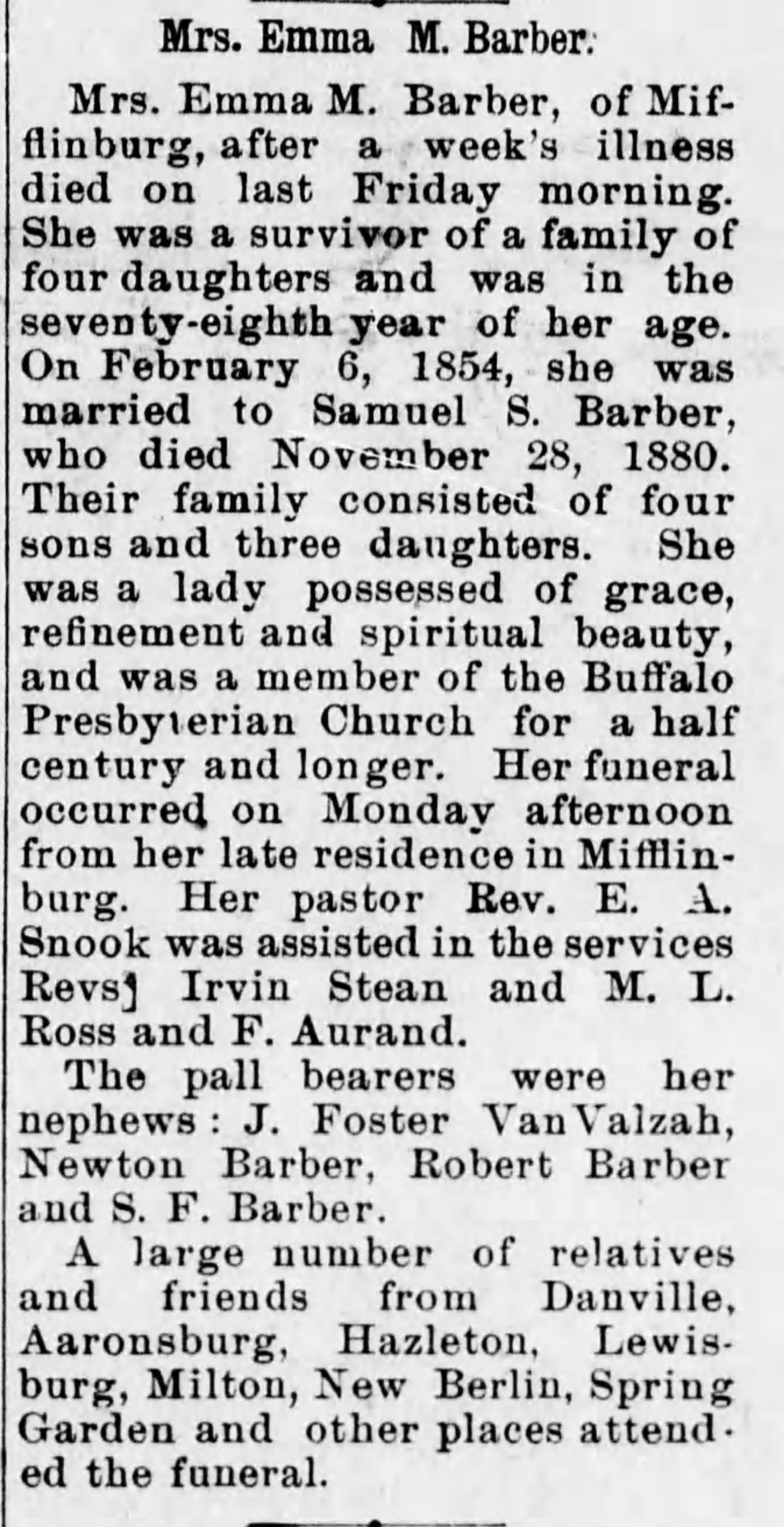
Samuel S. Barber
1819-1880

Emeline [Forster] Barber
Wife of Samuel
8 Sep 1820 - 14 Jan 1898


Samuel broke his knee cap, and within a week he had died.  Note the line "The injury will cripple Mr. B. for life in all probability because he is pretty well advanced in years".  He was 61.


Benjamin W. Thompson
4 June 1814 - 14 Jan 1887

Isabella [Maize] Thompson
1 Nov 1819 - 17 Jun 1890


In the census records, Benjamin W. Thompson of Chestnut Street in Mifflinburg was listed as an undertaker and marble cutter.  


William Piper Montelius
23 Jan 1842
16 June 1865 [aged 23]
Graduated from Lafayette College in Easton, PA 1864; Valedictorian; candidate for the ministry; died at Mifflinburg

Although there is a Civil War Marker at this stone, I found no record of William, nor his father, serving in the war. [That doesn't mean they didn't, merely that I didn't find a record of it]

Also on the stone are his parents:


Charles Montelius
15 Dec 1811
18 Jan 1882


Rebecca Howard [Piper] Montelius
1816-1866


==================
Obituary for Charles Montelius
Shopkeeper, Milliner, Mifflinburg Pa


===================
Rev. War Soldiers
[NOT a complete list.  Not even close to complete!]
Many of these stones were applied for in 1939, by then president of the Union County Historical Society, C.M. Steese.  The stones were shipped by railroad to the Mifflinburg P.R.R. station.


Information from the U.S. Headstone application form states:

Daniel Campbell
Unit 1st. Penna. Regt
Company Capt. James Parr
Enlistment Date 20 Aug 1776
Discharge Date 1780
Death Date 22 Apr 1793
Cemetery Mifflinburg PA


 A quick search did not turn up any information on a Daniel Campbell in Mifflinburg.   One genealogist lists Daniel as the son of  Capt. Laughlin Campbell of North Carolina.

 There is also another find a grave entry for a Daniel Campbell who died in 1834.  It's interesting that he is also listed as the Daniel Campbell that served in under Capt.  James Parr.  

Daniel was a Revolutionary War patriot who served as a Private in the 1st Regiment of the Continental line of PA under Capt. James Parr and Capt. James Wilson.Source: PA Archives, 5th Series, Vol. 2, pp. 648-649


Name John Reasner
Unit Frontier Rangers Northumberland Co.
Company Geo, Overmeyer's Co
Enlistment Date 1780
Discharge Date 1781
Death Date 1801
Cemetery Mifflinburg


John Reasner  owned  one hundred acres of land in West Buffalo, Twp.  On 8 Mar 1786 he transferred that land to his son, John Reasner II.


Conrad Auble 1758 - 1845
'Served as a dragoon in Count Pulaski's legion'

Hessian Soldier 

 "Conrad Auble or Aubel was born in 1758 in Hessel Castel, Germany. Conrad Aubel and his brother were among the Hessian German Soldiers, who's services were sold to King George III of England, by the Prince of Hess, and were sent to America to fight for the English Army in the Revolutionary War. During the battle of Trent, N. J., Conrad was captured by the Americans, after that he swore allegiance to America and fought against England. Conrad served with Count Pulaskie's Legion as a Dragoon on the American side. He was wounded sometime during his service in the Revolutionary War. He served as a bodyguard for Washington. It was learned he was receiving a U. S. Government pension of $45 a month when he died.

Legend has it that his brother Frank was two years older than Conrad and after the war settled in Hirkimer, New York and that a third brother went to Canada in the area of Nova Scotia. There is no accurate record of either one.

Conrad began his school teaching career in 1785 in Pennsylvania Twp Northumberland, Union Co., now Snyder Co., Pa. He taught in a German school for a number of years. In his History of Mifflinburg Richard V. B. Lincoln states that Conrad Auble taught school in 1809 and 1814 and for some years afterward. He belonged to the Elias Youngman German Lutheran Church.

With his wife Barbara he located in Buffalo Valley, Union Co., at an early date. Barbara Seebold Auble was blind for some years before her death, at the time of their death, the Aubles lived in Mifflinburg, they are both buried in old part of Mifflinburg Cemetery. Conrad  passed away in 1845 and is buried Mifflinburg Cemetery, Mifflinburg, Union County, Pennsylvania."


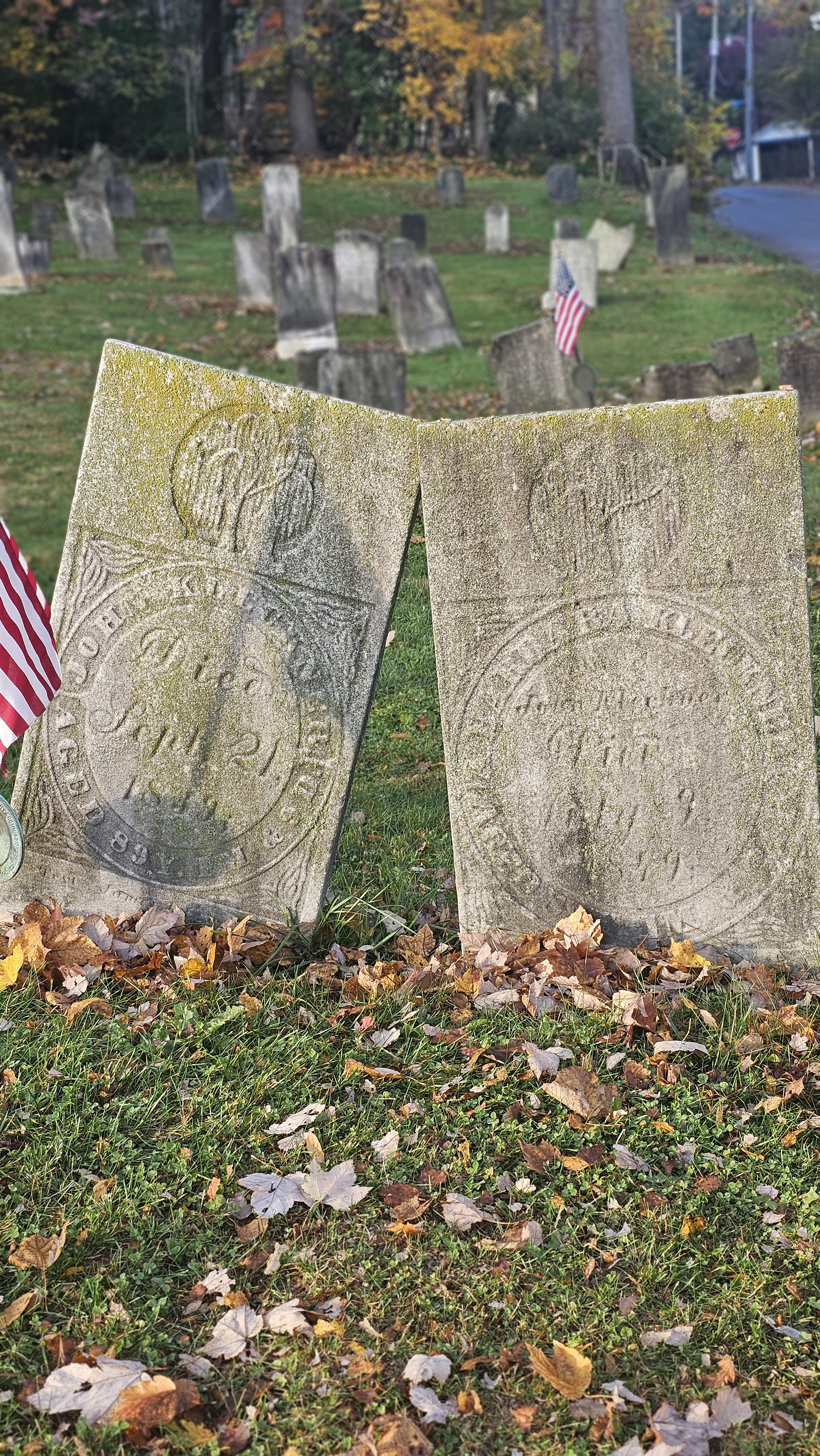
John Kleckner
Died
Sept 21, 1839
AGED: 89Y 1M & 9D

Anna Barbara [Koch] Kleckner
Aged 89 years, 1 month, 24 days.
 Wife of John Kleckner


PA Militia


Name John Kleckner
Birth Date 12 Aug 1750
Age 89
Death Date 21 Sep 1839
Military Branch Army
Veteran of Which War Revolutionary War
Registration County Union
Cemetery Name Old Mifflinburg So 5th Street Mifflinburg
Cemetery Location Pennsylvania 


===============
READ MORE
===============
Mifflinburg Cemetery, as it is commonly known, is actually a combination of two cemeteries.  Old Mifflinburg Cemetery, also known as Fairview Cemetery & Woodlawn Cemetery, is located on the west side of Rt. 304. The cemetery was established no later than 1817 but was likely utilized for about 20 years prior to that. The grounds on both sides are well maintained although many of the stones in the oldest part of the combined cemetery, behind the old Elias Church, are very difficult, if not impossible, to read.

The Mifflinburg Cemetery Association, with the interment records archived at the Mifflinburg Bank and Trust Company, maintains the cemetery. The cemetery is still active. To get to the cemetery, turn south on Route 304 (South 4th Street) from Route 45 in Mifflinburg.