Showing posts with label Schools. Show all posts

Sunday, April 6, 2025

The Mifflinburg Academy


The Mifflinburg Academy 

 Located on the corner of 6th and Green Streets, no longer stands.  Today the Mifflinburg Buggy Museum Visitors Center stands at this location.  The cupola from the top of the school is preserved in front of the visitors center.

The cupola from the Mifflinburg Academy, in front of the Mifflinburg Buggy Museum Visitors Center

According to a 1963 article, the Mifflinburg Academy began "in the Franklin School on the North Side of Market Street between Third & Fourth Streets" - Note that that location was the Franklin School, not the building shown here.  The building shown here, the Academy building, was located  on the northeast side of Green Street between 5th and 6th, where the Buggy Museum is today.

Rivaly between Mifflinburg and Lewisburg began in an 1827 debate.


1837


The Mifflinburg Academy "ceased to exist" in 1868.  On September 3 1894 it became the Grammar School.  The first floor of the school was used for "common school purposes" and the second story contained the hall of the Grand Army Of the Republic post. [according in a 1963 newspaper article]

A sign inside the Cupola reads:

"The architectural structure is the cupola from the Mifflinburg Academy.  The two-story brick building was demolished in the 1970s.  the first school in Mifflinburg was the German School, located at Fifth and Green Streets.  Classes were taught in German.  The Franklin School for English speaking children was located on Market street.  These two schools were subscription schools, which meant parents paid the teacher directly.  In response to the Public School Act of 1838, the Mifflinburg Academy was built.  As a public school, the Academy was supported by taxes.  It's aim was to teach the classics and encourage students to achieve higher learning.  The Mifflinburg Academy was closed as a school when the Mifflinburg High School was built in 1876.  The building was used to provide temporary housing for men looking for work during the Great Depression (1929-1941).  When the high school was overcrowded in the 1940s, the building was re-opened as an elementary school"

This page from the 1928 Mifflinburg Yearbook, The Nautilus, appears to contradict the above information - it lists some of the students who attended the Old Academy in 1916-1920.


======================

READ MORE
=====================
1924

1925

1925

High School Auditorium, 1927

Mifflinburg High school, 1928


"It is to the credit of Mifflinburg that she has never been behind her sister villages in the promotion of education The same day, April 14, 1827, the village was incorporated a Borough, an act was passed establishing an Academy here. Among the trustees named, of Mifflinburg, were Henry Yearick, Jacob Maize, John Foster and Michael Roush. Rev. Nathaniel Todd, a Presbyterian minister, was the first teacher. He was succeeded in 1839 by James M'Clune whose fame as a teacher spread over the State. Then came Prof. Henry. G. M'Guire, who was followed by the much lamented Aaron C. Fisher. These great teachers have all taken their departure to the other world, but their memory is still cherished by their students many in prominent positions, far and wide over this and other States.

The influence of the Mifflinburg Academy will never be fully reckoned until the judgment book shall be opened on the last day of final reckoning." - 1892 article about Mifflinburg's Centennial

Some early history of the Academies in Lewisburg and Mifflinburg


Wednesday, February 26, 2025

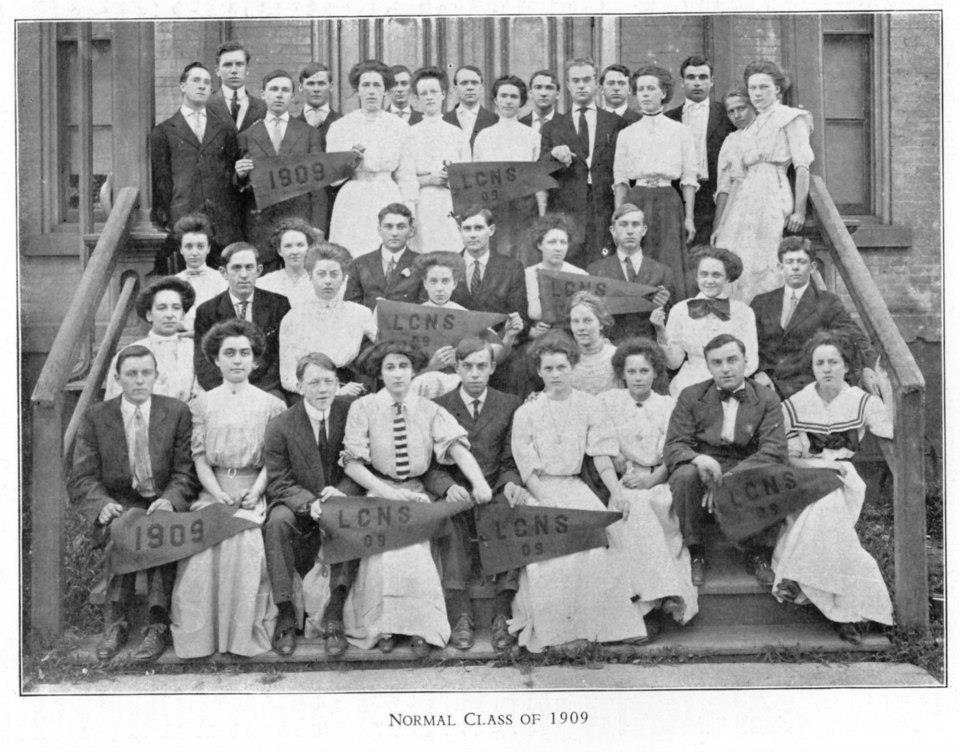
"The Normal" - Lycoming County Normal School


The Lycoming Normal School At Muncy


The Lycoming Normal School, sometimes called "The Normal", was first located in Montoursville Pa, and later in Muncy.


"Normal Schools" were established primarily to train teachers for public elementary schools.  The Normal School Act of 1857 created 12 normal school districts, spread geographically across the state. "Normal" referred to the teaching standards, or norms.


 Meginness, in his 1892 History of Lycoming County, wrote:  “before the establishment of [the Lycoming County Normal School], the teachers of the county had no acquaintance with the theory of teaching, or school government, and the advancement that was made was slow and unsatisfactory. . . . The Normal teaching presented new methods and theories, which were carried into the work of teaching, and the progress that was made was gratifying to all friends of popular education” 


The "Normals" evolved into state teachers colleges, and then eventually to State Colleges, before becoming State Universities in 1982.


The location in Montoursville was a four room high school building on  the corner of Montour and Jordan Streets.  That building was outgrown in a few years time, and a new building was erected in 1873, to house both the Normal School and the High School.  The Montoursville Normal School closed in 1877.


The Normal School Catalog for the 1913-14 school year listed estimate of approximate expenses: $56 per term, including tuition, room and board at a local Muncy home, laundry, and incidentals.

The Lycoming Mutual Fire Insurance Building
[NOT the Normal School building - but also used by the Normal School]

In 1908, the school needed more space so they acquired the former Lycoming Mutual Fire Insurance building on South Main Street, directly in front of the Normal School. The "Executive Building" offered additional classrooms, offices and a reading room.

The Normal School Building
Located on the corner of Market and High Street in Muncy - behind the Fire Insurance Building.

Muncy High School/Normal School

NOTE - the Fire insurance building still stands today, The Normal School building does not.   The Normal School building was torn down. 

 Both buildings were of somewhat similar design, and the photo above,  of the Normal School, was likely taken from the tower of the Fire Insurance building  - the Normal School being built behind the Fire Insurance Building.  

In 1927, The Muncy Normal School became a branch of Mansfield State College.  In 1938 the Normal School building was torn down to make way for Hoffman Seed and Grain Company.  Hoffman Seed and Gran was later razed, and the McCarty Apartment building was build on the vacant lot.


The schools marble block from the brick wall bordering market street was salvaged and moved to the property of the Muncy Historical Society.


================
CLASS PHOTOS & LISTS
===============
1890

1898

Florence Connelly 1898

1901

1903

1908

1909


1909

1910

1911

1912


1912


1913
1913 Class List


1913 Faculty


Students at the Train Station
From the 1914-15 Brochure

1915

Unknown Year


=============
READ MORE
============
Dr George Brecht first taught at Lycoming Normal, then was principal from 1890-1893 before becoming superintendent of the schools of Lycoming County.


1903 Harris Spotts Principal

1903 - A.M. Weaver, of Muncy, has been elected principal; of the Montoursville schools at a salary of $90 a month. Mr. Weaver has had several terms’ experience as a teacher in the Muncy Normal school and also as principal of the schools at Liberty.


1894 - "The Muncy Normal School, enters upon its 25th year with bright prospects and a very successful one."


Saturday, July 6, 2024

The School Program For The 1895 Lycoming Centennial


In the spring of 1895, in preparation for the Lycoming County Centennial, a " Diploma  Contest" was held.   

The  committee  offered  $60.00  in  prizes  for  the best  six  papers  read  at  the  celebration  and  prepared  by  pupils of  the  public  schools;  $30.00  to  the  pupils  of  the  county  schools, and  $30.00  to  the  pupils  of  the  city  schools:  First  $15.00,  second $10.00,  and  third  $5.00.

"Mr.  McMinn,  in  the  preparation  of  the  supplemental program,  assigned  one  or  more  topics  in  every  district, borough,  and  ward  of  the  city,  for  pupils  to  write  upon, believing  that  if  the  papers  were  carefully  prepared  a great  deal  of  interesting  local  history  could  be  rescued, which  otherwise  would  soon  be  lost  beyond  recovery.