Showing posts with label Women. Show all posts

Friday, August 29, 2025

Elizabeth Lyman Nice, And The Early SPCA In Lycoming County


Elizabeth [Lyman] Nice, wife of John Nice

Elizabeth Keziah Lyman Nice (1832 – 1895) was a woman "known by reason of the zealous and unflagging devotion to humane enterprises, having practically given up her life to philanthropic work", according to her obituary.  She dedicated her life to the care of others.

"Others" was not limited to just people - Betsy was also was dedicated in the protection of animals from abuse by their owners. She  established a branch of the Society for the Prevention Of Cruelty to Animals in Lycoming County.  As her obituary stated, "She was untiring in showing up and bringing justice those who maltreated dumb brutes." 

Mrs. Nice had once mentioned that it would serve the horses well to have a water trough near the park.  

In 1895, Mrs Nice developed typhoid fever, and died.  A committee was formed to raise money for a monument to honor her, and more than $1000 was raised. The monument, which would be placed near the entrance to Vallamont Park, was to feature a water trough for horses.

On August 12th 1895 - The Sun Gazette reported that the Nice Memorial Fountain at Vallamont was almost completed.  The fountain, with two water bowls, was in memory of Mrs. Nice, and was erected by by the Society for The Protection of Cruelty To Animals 

=============
The Horse Drinking Fountain
=============
The Horse Statue At The Entrance To Vallamont
The fountain was placed at the intersection of 1st Avenue and Prostpect Terrace [later renamed Vallamont Drive]

August 12 1895 


The fountain proposed to be erected in the memory of Mrs Niece, by the Society for The Protection of Cruelty To Animals

1895

The monument was located at the bottom of this road, and can just, barely, if you zoom in, be seen in this photo.

An article in the Sun Gazette states that the statue was moved to the East End of the Golden Strip, but exactly where, or when it was removed, is unknown.

=================
READ MORE
================

More about Vallaont in Williamsport - https://susquehannavalley.blogspot.com/2020/05/vallamont-park.html


================
Note - most write ups about Elizabeth say that Elizabeth Lyman was born in 1832 in New York, the daughter Of Richard Lyman, a physician.  Both her mother and father had died by the time she was 13 - her father having been killed in an accident with a "vicious" horse. 

Personally, I could not verify that. [Which does not mean it's not true] .  

Sometime between 1860 and 1867, Elizabeth married John F. Nice, who was listed in the Williamsport Ward 2 census as a Photographer.  John had a photography business in Jersey Shore, then Lewisburg, before settling his business at 3 East 3rd street in Williamsport, and a home at 329 Maynard Street.


John F. Nice [Husband of Elizabeth Lyman] and Robert Y. Nice, brothers, were both photographers in Williamsport Pa.  They appear to have always maintained separate studios.

Both were sons of George and Eleanor [Marroly] Nice, in Jersey Shore, Lycoming County Pa.  Although his death certificate lists his father as John, I'm [mostly] certain that is a mistake, his father was George.

After Elizabeth [Lyman] Nice died, John remarried, to Elizabeth Hepburn.  John and both Elizabeth's are buried at Wildwood Cemetery.  John & Elizabeth [Lyman] are listed on the front of the stone, Elizabeth [Hepuburn] 1847-1922, is on the back.

George and Eleanor, John's parents, are buried at Jersey Shore.  I found it interesting to note that the tombstone is very similar - nearly identical - to John's stone at Wildwood.

In 1850 John was 15 years old, living with his parents in Jersey shore, with the occupation of Coach Maker in the Railroad and Misc Transportation Industry. His father had the same information for his occupation.

In 1860, John is still found in the Jersey Shore census, but now he is in a list of names found under Hugh Shaw, hotel keeper.  His occupation is listed as Daguerrean [photographer].  Daguerrean refers to the early photographic process invented by Louis-Jacques-Mandé Daguerre, where a mirror-like silver copper plate image is produced. The census lists John's personal estate at a value of $500 - twice that of the only other on the list of hotel residents with an amount listed.  In later editions of the Gazette and Bulletin, under a column titled 'looking back", Nice is noted as having been a photographer since 1857.

Sometime between 1860 and 1867, John married Elizabeth. By 1868, John had a photography studio in Williamsport, advertised as "in the Mussina Building" No 3 East third street, corner of Market, Williamsport Pa. "   Jacob Lyons Mussina 1807-1888, was a clockmaker.  He built a new store on the northeast corner of Market Square in Williamsport in 1858.  In some photographs of the building, a sign for "R.Y. Nice Photography" can be seen.  Robert Y Nice 1848-1929 was the younger brother of John.

Elizabeth Nice was added to Williamsports First Baptist Church membership list on March 11 1867.  [Her membership was dropped Oct 6 1877, with a note to "see minutes Folio 458".]  


  In 1870, John is a photographer in Williamsport, with a personal real estate of 6,000.  Elizabeth is 3 years older than him, 38 to his 35.  A 19 year old Elizabeth Hood resides with them, with the occupation of "Working Photo Stall".  Miss Hood was also from New York state.  In 1875 the Daily Gazette in Williamsport reported that John F. Nice "and lady" are visiting friends in Illinois.

1875 Directory

In 1879 John was listed, along with John D. Fessler [?] and William N. Jones, in a lawsuit against Horace F. Taylor and Peter Herdic, "having conspired together to defraud them."  The charge was in regards to "certain certified checks marked by H.F. Taylor as good; said checks purporting to be drawn upon the banking house of H.F. Taylor, and Peter Herdic not having the money there to meet them...  obtained large sums of money thereon to wit: $16,000 [the equivalent of about $51,000 in 2025] from R.W. Adams and Co, John F. Nice, and others."  

Still in Williamsport, on "May West Street" [West Maynard], the 1880 census tells us that Elizabeth's parents were from Massachusetts.  Now Elizabeth is listed as 5 years older, 48 to John's 43.  In 1889, the Williamsport Directory lists John at 329 Maynard Street, Williamsport. 

329 Maynard Street is located across from Ways garden, two houses back from Backhouse Coffee.  John lived there until his death in  


John was also a painter, in addition to a photographer.  In 1882 he had a painting exhibited a the second annual Lycoming Agricultural Fair.


By 1883, Robert Y. Nice, brother of John, had his photography studio at Market Street.  In the 1875 directory, both John and Robert are listed as photographers, at different addresses.  John was at the Market Street location, and Robert was at 62 1/2 Lycoming Street.  In 1878, John was advertising the property at 62 1/2 Lycoming for rent - "a neat little cottage six rooms, hydrant water..." In January of 1883, Robert was "laid up with illness but improving slowly.  The Daily Gazette and Bulletin said that "his business was kept going by competent workmen" , with no mention of his brother John.  In 1884, Robert moved from South Williamsport to "fourth street below Mulberry".  The photo of the Russell Tavern so often shown in historical publications, the building that served as Williamsport's first court house, was taken by Robert Nice.

In 1890, Dr. W.H. Messimer and family "arrived at the home of his brother in law, John F. Nice" on Maynard street.  "From Florida, in a shivering condition, well prepared to enjoy that 'open-gate fire' in opposition to Dr. Doane in Colorado"  William Hilbbris Messimer married Rachel Ellen Nice, sister of John Nice.  

In 1891, the editor of Globe Magazine, Philadelphia, was a guest at the Nice home.

In 1900 John was widowed, owned his own house, and was still a photographer.  His housekeeper was "Lizzie" Hepburn. [In 1877, Lizzie Hepburn was a seamstress, staying at the American House Hotel].  

An article in the Gazette and Bulletin, Dec 29th 1902, reports that John and Miss Lizzie Hepburn were married in the Parlor of Mrs. John M. Pross of Lewisburg.   "Mrs. Pross is a sister of Mr. Nice."

Assorted articles in the Gazette and Bulletin mentioned the Nice's keeping bees, and feeding birds.  [These articles would refer to the second Mrs Elizabeth Nice]


In the 1910 census, John and Elizabeth [Hepburn] are married, with the census reporting that they had been married 7 years.  When Elizabeth [Hepburn] Nice died in 1922, John gave the information for her death certificate.  For her birth place, parents, and parents birth place, he reported, over and over "Don't know".  Her birthdate was listed as Feb 4th 1847, and she died on Dec 29th 1922.  


In 1911 John offered a $25 reward for the arrest and conviction of the person or persons who destroyed the fence around his property at the corner of Maynard and Vine on the night of October 31st.

In 1913, a thief broke into Nice's house and stole ham, bacon, beer, and liver.  They also ate half of an apple pie. 
=========================


Market Square, 1906. On reverse of photo: "1906 Boyd's Directory: Jacobs, Harry A., Clothier, hatter and furnisher, 2 W. 3rd and 309 Market, h. 506 W. 3rd. Kline and Co. (James N. Kline) hardware, 15, 19 and 21 E 3rd. Nice, Robert Y, photographer, 3 E. 3rd, h. 638 Market, South Side. Mussina S. and Son (William V.) jewelers and opticians, 1 W. 3rd (Northeast corner Market Square) (1989 - Jersey Shore State Bank)."


Tuesday, January 14, 2025

Reminisces of Mrs Robb - The Daughter Of A Canal Boat Captain


A list of those appearing in this photo is included below.

In August of 1925 the Harrisburg newspaper ran an article with stories from the reminiscences of Mrs. Robb.  Ellen Jane [Miller] Robb was the daughter of Jacob B. Miller, an old canalboat captain.   She grew up not only riding on, but steering and driving, her fathers boats.

=======================

Lock Haven, Aug. 10. [1925] - Of the large number of boatmen and women in this vicinity in the days of the canal less than twenty are still living. In the above picture are shown: 

Front row, seated, left to right, C. A. Lufer, Captain William Gummo, Frank Fabel, E. C. Gibson, Joseph Hunt, Frank Henry, Michael Dennehy and Captain Jacob Scheid. 

Back row, standing, left to right, A. W. Rokenbrod, Miss Catherine Fabel, E. J. Barrett, Mrs. John A. Robb, Mrs. Caroline Barrett and Mrs. E. L, Wolfe. 

Captain Jacob Scheid is one of the oldest canal boatmen living here, being in his eightieth year and Mrs. E.L. Wolfe is the youngest, just past forty. The completion of the West Branch canal from Northumberland to Lock Haven, which culminated in the construction of the dam across the West Branch of the Susquehanna River just east of Lock Haven in 1833 and 1834 was the beginning of an era of unprecedented prosperity in this section. The work on the dam was started in 1833, and 1,500 laborers, largely of German and Irish extraction, were engaged in the  construction of the dam. In the fall of 1833 serious disputes between the two nationalities ended in the peace of the community as well as the lives of the residents being threatened, and it was necessary to to call out the State militia to quell the riot.

The dam, when completed, was 850 feet in length, and the length of the chute was 600 feet. The water was let into the canal first on the night of October 16, 1834, and four days later the first canal boat came through. 

Reminiscences of Mrs. John E. Robb, of 422 East Bald Eagle street, Lock Haven, widow of Professor John A.Robb, who for more than thirty years was superintendent of the Lock Haven schools, give a good idea of the travel the canal in  the old days. 

Mrs. Robb was the daughter of the late Jacob B. Miller, an old canalboat captain, who owned and operated canal boats during entire period of Mrs. Robb's girlhood, and invariably took his family with on his trips, so that her earliest recollections were of life in a canal boat. At little more than kindergarten age Mrs. Robb thrilled when the canal boat passed under the old-fashioned high bridges, which were later replaced by the swinging bridges which swung aside for the boat to pass through, on which there was usually a cargo of small children, getting a free ride.

Took Long Trips

 The longest trip Mrs. Robb recalls making on their canal boat lasted between seven and eight weeks, during which time the family of four and several members of the crew lived on the boat. Captain Miller on this trip took a load of iron ore at Lebanon and carried it to Danville; he then went on Pittston and get a load of hard coal for Elmira, N. Y., and on reaching Elmira found that the coal had been sold to a company in Syracuse, and carried it on to that place, where he loaded his boat with  salt for Wilkes-Barre. On reaching that city he found that a part of the salt had been sold to Juniata Junction, and went on with it to that place. After unloading the salt he proceeded to Huntingdon where he got a load of soft coal for Philadelphia. 

Boats Well Built

 The canal boats were built very well, Mrs. Robb said, explaining that the kitchen was at the foot of the stairway, and told of the compact cooking arrangements, with place for the kettles and pans under the stove, where sort of a cupboard was constructed. There was a tiny dining opening off the kitchen, which served as a living room also. When the boat carried  a small load, or was empty, the children loved to play in the hull of the boat, Mrs. Robb said, and told how they had constructed swings from the rope and hatches, where they swung as they sailed over the smooth water of the canal. There was little frolicking while crossing the river at Clark's Ferry or from Havre-de-Gras to Baltimore, on the rough craters of the Bay, she said. 

At Ferry 

a pilot was furnished by the Pennsylvania Railroad Company, who stepped on the boat at the farther side of the river, and steered the boat safely past the danger line. At Havre-deGras there were strings of boats lined up four abreast and six or eight deep, which were taken across the bay steamer.

Drove at Eight Years

 When she was between seven and eight Mrs. Robb drove the mules while the crew were at dinner, and states that the walk along the towpath, which abounded with berries within easy reach of a small girl, was most fascinating. She could ride a mule, too, although her father never encouraged this and before she was 12 years old Mrs. Robb could steer canal boat heavily loaded, and stay in the middle of the stream, although she says this required as much care and constant heavily laden then motor truck, and attention as operation of a especial care had to be given on to the passing of other boats in the canals, the heavily laden boat passing over the lighter laden boat's lines, which were dropped by the one steering the craft.

She was born and lived in Lebanon county until she was about 19 years of age, when she removed to. Lock Haven with her husband, her baby, her parents, and an uncle and family, the three families, with all their household possessions, including a half ton of hay, pigs and chickens, coming to Lock Haven on the Miller canal boat..


Wednesday, March 8, 2023

Laurelton Village - The Home For Feeble-Minded Women


The Laurelton State Village For Feeble-Minded Women Of Child-Bearing Age was a modern, and expensive, facility, located in a very rural part of the Pennsylvania. The location was chosen in 1914, construction began in 1915, but it was 1920 before the facility was able to accept their first resident.  It was originally built with the goal of providing a facility to house, educate, and train feeble minded women, while keeping them from reproducing, as feeble-mindedness was believed to be a hereditary trait.

Tuesday, February 7, 2023

Esther McDowell - A Singular Story


Esther McDowell was found in October of 1803 tied to a tree. Sheltered in the home of a local reverend, she told a story of a companion who robbed her while possessed by evil spirits.   Actually, as it was later discovered, Esther had tired of her Quaker lifestyle, and ran off to work as a local tailor, while pretending to be a man.   Tiring of her ruse, she faked the robbery and tied herself to a tree, waiting to be discovered.

Wednesday, October 26, 2022

Mary Wiley Staver , Jersey Shore Authoress

 
Rhymes and Rythms
and Histories Droll
For  Boys and Girls 
from Pole to Pole

Written by Mary Wiley Staver of Jersey Shore
Published October 1891

Monday, June 27, 2022

QUEEN ETTA, The Seneca - The Life & Death Of A Social Outcast


 QUEEN ETTA, THE SENECA
LIFE AND VIOLENT DEATH OF A SOCIAL OUTCAST
........................................
A Strange Family Of Savages Who Dwell in Caves and Cabins in the Woods Of Western Pennsylvania
----------------------------
 A party of sportsmen, who have been bear hunting in, the wilds of Potter Co., near the little town of Abbott, report the finding of the body of Goble, a notorious character, who has been missing from her home in the mountains near -Wharton, for several months. 

Her death was a most horrible tragic one, and a fitting end to a strange life (nil of romance and misery. Etta Goble was ono of a large family of half-savage people known as "The Krabels." This strange family is said to number from 200 to 350 men, women and children, and a more degraded lot of people it would be hard to find in the United States. They dwell in small caves and cabins in the wooded hills of Potter Co., and on the borders of Cameron and Clinton counties.

 Despite their Dutch name the Krables are undoubtedly of Indian descent, the Seneca breed, they claim and they all bear the peculiar facial marks of their ancestors, while their habits and mode of living are even more indecent and less cleanly than those of their uncivilized forefathers. They intermarry exclusively, and no divorce is necessary to separate man and. wife, if either par ty desire such separation. Marriage services, of a peculiar sort, followed by an incantation, are performed by the "sage" of the tribe, and the occasion is one of the most open defiance of all laws of morality. The results of the defiance of physiological laws, by intermarriage, are evident in the forms of their children. Many of them are idiots, some are strangely deformed.

 A BEARDED FEMALE FORTUNE-TELLER

 Such is the race or family to which Etta Goble belonged, or rather with which she lived, tor she frequently declared that she could boast of purer Indian blood than the rest of the tribe. She was always regarded with a great deal of awe by her associates, and she was treated with as much deference as gypsies usually pay to their "Queen," and with as much respect as Indians show to their "medicine men." She was reputed to have been the seventh daughter of a seventh daughter, and was, in consequence, believed to be endowed with the magic power of curing all kinds of bone fractures and diseases. She was a fortune- teller of remarkable skill and her hand was crossed with silver by many a backwoods maiden who desired to know her future, and whether her rustic swain was true to his vows.

 In appearance "the Queen," as she was usually called, was somewhat, startling. She was nearly six feet nine inches in height, her skin was a saffron-yellow, her hair long, coarse and black as a raven's wing, and her chin was covered with a beard at least three inches in length. She adopted the regular Indian costume and lived alone in her small cabin in the woods, midway between Abbott and New Bergen. During her summer excursions to Coudersport and Emporium she was constantly besieged by people who wanted the future revealed to them by this wonderful fortune teller. She made some wonderful predictions. She foretold the assassination of President Garfield ; she predicted the strike of the famous oil well "646," and she warned the people of Ridgway, Elk county, not very far from Emporium, of the fire which recently laid that town in ashes.

 A DANGEROUS PET.
 She made money and knew how to save it. She rarely spent a cent except for liquor, and one of her peculiarities was that she would never allow any human being to sleep in her cabin, not even her own brother, and those of the tribe who went to visit her always went prepared to sleep out of doors. She had a pet rattlesnake whose fangs had never been drawn, and she frequently boasted that she did not want a better protector. There was an annual gathering of these wandering people, usually held at Etta's cabin, and these convocations were the wildest orgies imaginable, and more than one member ot the great family has been missing after the long debauches in the lonely wilds of Potter county.

"Queen Etta" was last seen alive the day before Thanksgiving, when she was as frisky and as full of whisky as usual. Just before Christmas one of the Goble tribe, while in the post-office at Abbott, casually remarked, "Queen Et' haint t' hum no more, and I sh'udu't wonder ef she hed kicked the bucket afore this, on 'count o' th' hard winter." One of the bystanders made a trip to her cabin next day and found it deserted. On the earthen floor ,in one corner of the room, lay a half bushel of chestnuts and walnuts, while to the beams supporting the thatched roof hung a ham, the half decayed body of a chicken and a string of red peppers No signs of "Queeu Etta" were anywhere to be seen, and after a two days' search the neighbors concluded she had gone to join the rest of the tribe near Millport.

A few days ago the party of hunters from Conders- port, first referred to, were chasing a black bear through the swamp near the cabin where "the Queen" formerly lived, when one of the hunters stumbled and fell over what he supposed to be a stone, but which, upon closer examination proved to be a human skull, still covered with patches of bloody skin and hair. Upon communicating his discovery to the people living in that vicinity they came to the conclusion that the skull was that of "Queeu Etta," the peculiar shape of her head corresponding to the shape of the skull. Suddenly one of their dogs stopped and commenced barking furiously under a chestnut tree on the hillside.' Running to the spot the men discovered that the dogs had scented a partly decomposed body. It required but a brief examination to convince them that the remains of the old "Queen" lay before them. She had climbed the chestnut tree to shake down some nuts when the limb, in the top of the tree broke, and she fell a distance of at least thirty feet. A large jagged stump of a tree that had been shattered by lightning, caught her body as she fell, and one large splinter of it was thrust entirely through her body, impaling her. Her death must have been instantaneous. A bear, or some other carnivorous animal, had gnawed away her feet and hands, which had hung nearly to the ground, and it was undoubtedly a bear that had torn her head from her body and carried it into the swamp.

 A BONFIRE OF A COFFIN. 
The news of the recovery of "Queen Etta's" body spread like wild fire through the sparsely settled districts, and the Goble family gathered in full force to attend the "Queen's" funeral and to dispose of her body, which had been encased in a cheap pine coffin at the expense of the county, and placed in her cabin. It was on a Wednesday afternoon that at least two hundred of these half-savage men and women assembled at "Queen Etta's" hut and held a wake over the mangled remains. They indulged in drunkenness and wild orgies for two days. The clergyman who went from Wharton to read the burial service was driven from the spot by the drunken people, and they made an illumination in his honor by splitting the coffin to pieces and burning it. The next day they departed, after having set fire to the cabin. What became of the old woman's body no one can tell, for it is said, to be a custom of the Tribe  never to leave any trace of the burial-place of any of its members. 

======================
The Williamsport Sunday Breakfast Table, Feb 18 1883

Similar reports were carried in various newspapers, all the way to Vermont.


Thursday, June 23, 2022

When A 28 Year Old Dancer From Williamsport, & A Groundhog, Died In A Flight For Science, 1932


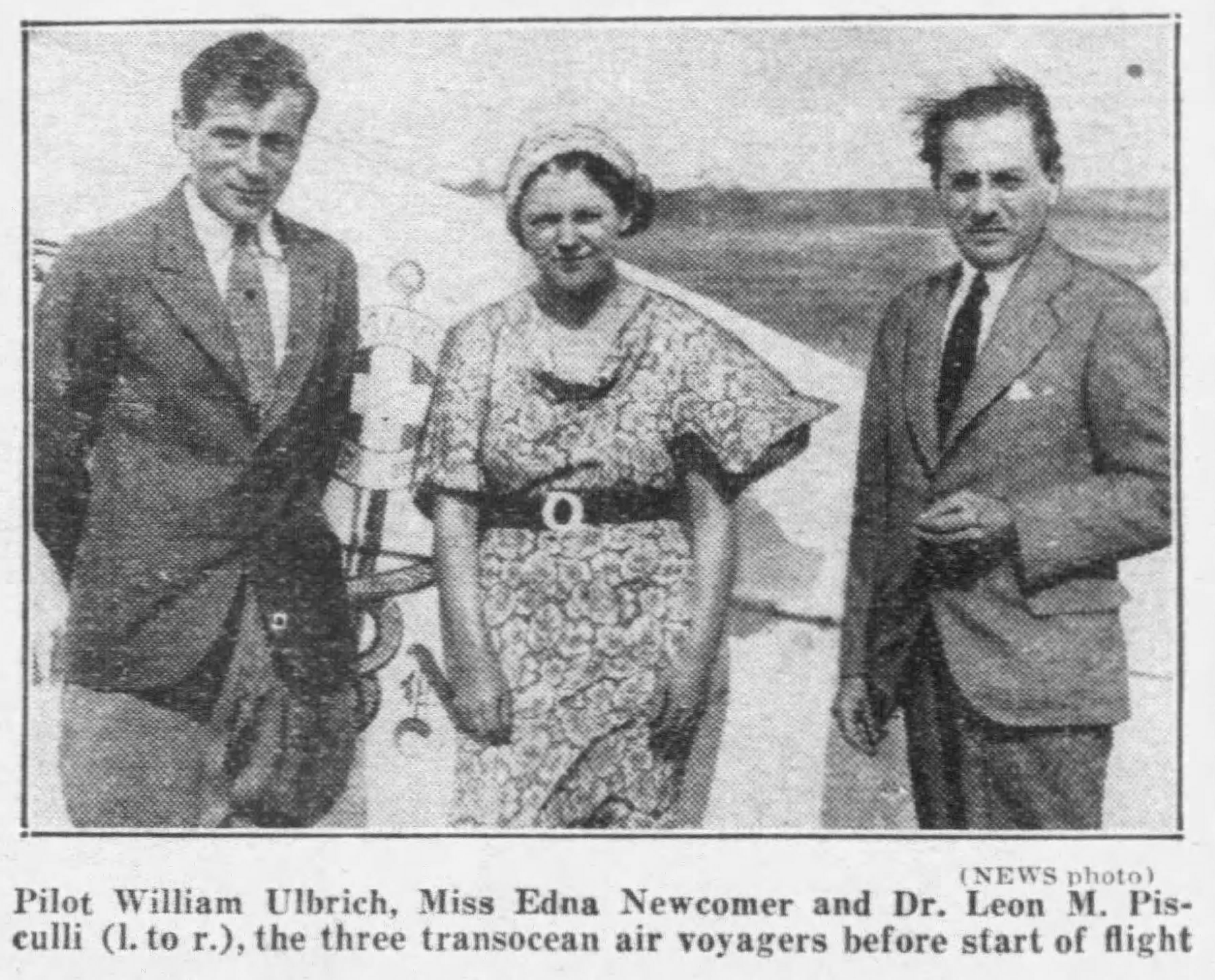
A 28 year old dancer and night club host from Williamsport Pa, a ground hog, a retired gynecologist, and a barn stormer pilot, attempted a Trans-Atlantic flight from New York to Rome.  The purpose of the flight was to monitor carbon monoxide levels in the cabin during flights, and in addition, Edna Newcomer who also had training as a nurse, held a pilots license, and had parachuting experience, would parachute into Florence in a tribute to Florence Nightingale.  Two prior attempts to fly from New York To Rome had failed, so if they succeeded, they would also be the first to make this flight successfully.  Unfortunately, they never arrived in Europe, and the plane was presumed lost at sea.

=========================================

The plane, the former Miss Veedol, was purchased by a group including Dr. Leon Martocci-Pisculli.  Pisculli recruited pilot William Ulbrich, with Gladys Bramhall Wilmer as co-pilot, for a record New York to Rome flight, including the proposed parachute jump in honor of Florence Nightingale over Italy. Wilner was a nurse, licensed pilot, and experienced parachute jumper, was an ideal candidate for the flight.  At some point however, Wilner decided not to take part in the flight.  She was replaced by Williamsport native, Edna Newcomer. 


Dr. Pisculli's intention for the flight was to study the effects of fatigue in long-distance aviation and to test his hypothesis that the loss of many previous long-distance flights had been due to the buildup of carbon monoxide in the crew compartment. Pisculli, who served as commander of the flight, held at least 3 patents for medical devices, he was also the founder and director of the American Nurses Aviation Service, which sought to promote the provision of medical care in aviation and through aviation to others.  As the flight was being sponsored by that Ameerican Nurses Aviation Service, the plane was renamed The American Nurse.


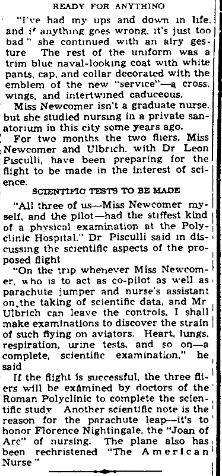
On the trip, the nursing assistant, who would also serve as co-pilot and parachute jumper, would take in charge of taking scientific data. When Ulbrich could leave the controls, Dr Pisculli planned to make examinations to discover the strain of flying on aviators.  "Heart, lungs, respiration, urine tests, and so on - a complete scientific examination."


A groundhog was also along on the flight, a mascot named "Tailwind".  Pisculli had found the woodchuck with a broken leg on a road in New York, and had nursed him back to health.  Tailwinds presence was presumably to be an early indicator of noxious carbon monoxide, much like a canary in a coal mine, however it was likely also, at least partially, a publicity stunt.

There were only two trained nurses in the US, at that time, that also held pilots licenses and also had a working knowledge of parachutes.  Once Wilmer declined, that left 28 year old Edna Newcomer of Williamsport PA.  
 
In September of 1932, 7 women had attempted to make Trans-Atlantic flights, and only two had succeeded.  Five had died trying.  Newcomer, the 8th woman to make the attempt,  was the first to have been invited along on a flight, the other women all having got their own backers and planes, and then found pilots to go with them.

Edna, 28 years old at the time of the flight, was the daughter of John Harrison Newcomer and Rebecca May [Shatto] Newcomer.   Her mother Rebecca, in 1932, resided at 812 Packer street, Williamsport Pa. Edna was born and raised in Williamsport, and attended the schools there.  

On her 20th birthday, she attended a musical comedy that was playing at the old opera house on West Third Street.  Soon after she left the city to become the bride of Jimmy Hodges, an actor. Upon her separation from Hodges, she retained her maiden name.


A few years later, Edna was one of a few actresses who submitted to a surgical operation in the hope of having her slightly bowed legs straightened.  After the surgery, she remained in a Chicago hospital for six weeks.  She then returned to Williamsport, where she had to remain in bed for the entire summer.  When the bandages were finally removed, she had forgotten how to walk.  Her brother John, who lived at home with their mother, took her out on the streets at midnight, where she could practice walking without being observed.

A  Broadway dancer and night club hostess, Edna soon became interested in flying, and by the fall of 1932 had 350 air hours to her credit.  She studied for 18 months at Roosevelt Field, and had recently became a parachute jumper.

When Edna spoke to her mother about the invitation to join the flight, her mother said "Go to it Edna!  You'll make it." Rebecca had occasionally traveled with Edna when she was in the musical comedy shows, she went to Chicago to be with her daughter after her surgery, and she planned to live with Edna when Edna returned from Rome.

The Williamsport Grit reported, in August of 1932, that Edna was "heralded as the first flying nurse of the American Nurses Aviation Service Inc, breveted as a flight nurse assistant and graduate parachute jumper." 

Edna was not a graduate nurse, but she had studied nursing in a private sanitorium in Williamsport.  

When asked how she felt about the "flight for sciences sake", Edna answered:
"It'll be the greatest thrill of my life - this flying the ocean.  I'm doing it for adventure.  I had my first parachute jump the other day, and it was great.  No, I won't be afraid of the long grind across the ocean or the leap at Florence".

Note - This contradicts earlier articles saying Edna had prior parachuting experience.

"I've had my ups and downs in life, and if anything goes wrong, its just too bad. "

When the crew first went to the airport in New York, Rebecca Newcomer, Edna's mom, accompanied her.  Bad weather however, delayed the flight, and Rebecca soon returned home.  She told her daughter, " not to bother about letting me know about the flight until you get to Rome."


Edna's uniform for the flight included a white cap, a trim blue naval looking coat with white pants, and a collar decorated with the emblem of the new American Nurse Aviation Service - a cross, wings, and intertwined caduceus.

Before the flight took off, Edna sent a telegram to a friend.
"Your lady bird spreads her wings to span the Atlantic, so wish me well before I go to hell. Or is it just another transatlantic flight? Answer cablegram to Rome if..."

Before boarding the flight, Edna Newcomer ran back to an automobile and got a small handbag she had packed with clothes "to use on the other side"


The American Nurse took off from Floyd Bennett field a little after 6am on Tuesday September 13th 1932.   Ulrich planned to fly over Cape Cod, and from there fly 1,000 miles due east along the 42nd parallel, and then veer slightly south to strike the Spanish coast in the vicinity. 

 Pisculli hoped to set down at Rome 24 to 26 hours after take off.  He announced that, before landing,  Miss Newcomer, a former dancer with "million dollar legs", would step out of the plane and descend by parachute at Florence, Italy, as a tribute to Florence Nightingale. 


By Friday, September 16th 1932, the plane was officially missing. Air officials felt certain it had not arrived over Europe at all, "for if she had, the pilot would have flown low to get his bearings and doubtless would have been recognized."


There were numerous reports of possible sightings, but the last verified sighting was by the S.S. France, 400 miles from its European landfall.
 

This was the 3rd failed attempt to reach Rome from New York, by airplane.  In 1927, Old Glory was lost at sea.  In 1929, pilots Roger Williams and Lewis A Yancey started for Rome, but only got as far as Spain.


===========
READ MORE
============
For the Genealogists:

Edna's mother was named as Rebecca in many news reports.  She was 83 years old in September of 1923.

Rebecca Newcommer waited for news at the home of her sister, Mrs Frank Blaker, Russell avenue, Kenmar.

A photo shows a younger Edna Newcomer, listed as the grandaughter of Rebecca, waiting by the radio for news.  There's no mention of Edna having a daughter sharing her name, so this is likely a niece of the Edna who made the flight.

[Birth record for Edna Newcomer, 1910, lists William & Mimi as parents]

Asher M. Newcomer, of Meriden Connecticut, was mentioned as a cousin of Edna.

The Bellanca J-300 Miss Veedol, with pilot Clyde Pangborn and passenger Hugh Herndon, Jr., made the first successful nonstop flight across the Pacific. The aircraft was sold to a group including New York gynecologist Leon Pisculli and renamed THE AMERICAN NURSE with the intention of flying the Atlantic to Rome with pilot William Ulrich, copilot, nurse and parachutist Gladys Bramhall Wilner and a pet woodchuck named "Tailwind"  (Wilner declined to make the flight, and Edna Newcomer took her place)

The plane was formerly known as Miss Veedol, which was originally  intended to make the first non-stop trans-Pacific flight, in an attempt to win a $25,000 prize offered by a Japanese newspaper.

That flight was a bit of a disaster, with the plane being loaded well beyond maximum capacity, it could barely take off.  Then the engine became starved for fuel, and the pilot had to dive to 1400 feet to get the ending restarted.  When Panghorn took a break to get some sleep, his co-pilot wandered off course, missing both Vancouver and Seattle.
Then the weather would not cooperate, and they could not find a safe place to land.  They finally made a belly landing, having disposed of the landing gear over the pacific. The plane was damaged, but repairable, and the propeller is still on display at the  Wenatchee Valley Museum & Cultural Center in Wenatchee, Washington.


The flight did qualify for the prize money offered by the Japanese newspaper, but as Herndon and his mother were the primary financial backers of the flight, they kept most of the prize money, in addition to the money from the sale of they sold the plane.

Nov 1, 1910

=======================

Heiser, W. H. (2006). U.S. Naval and Marine Corps Reserve Aviation, Volume I, 1916-1942 Chronology. (n.p.): Dihedral Press.