The town that is now known as Montandon began as Lewisburg Junction, little more than a train station, in 1825. It was, and still is, frequently referred to as "East Lewisburg". In 1861 the town was named Cameronia, and in 1867 that name was changed to Montandon.
In a list of how local towns got their names, I found this note that Montandon was named for a watch found in a well. That's not what the Keystone marker above says..but we'd need to find the whole story about the watch to know what the connection may be.
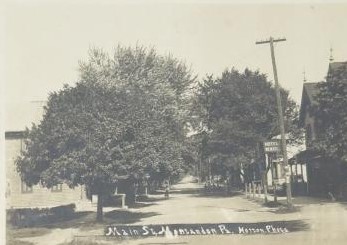
Undated Photo of Main Street Montandon
Named Cameronia, in 1861
The Sunbury Gazette, July 1861
Cameronia was named Cameronia in honor of the Cameron family
William Cameron was responsible, for among other public works, the contract for the cross-cut canal at Lewisburg. Opened in October 1833, the cross cut connected Lewisburg to the canal along the east side of the Susquhanna River.
In 1867, the local papers were full of an animated debate about the pursuit of an independent school for the town of "Cameronia" (The article above is merely facts, not the editorial debate that ensued)
Undated photo, Main Street Montandon Pa
Why The Change To Montandon?
In April of 1867, the Northumberland Democrat reported that the citizens of Cameronia were discussing changing the name of the town, because their mail was consistently, accidentally, being sent to a post office in Cameron County with the similar name of Cameron.
The only history I have found on Peter Montandon is listed on the sign as you enter the town. "Named for Peter Montandon, famous Huguenot leader." I can find no evidence that the Huguenot leader had any ties to the area.
=================
Read More About The History Of Montandon:
"Between the years 1828 and 1834 the ground upon which the town stands was used for a race course by the Foresman brothers, who were great horsemen. Horses were brought from adjoining counties, and the inhabitants from far and near would congregate at this place to witness the races.
In 1840, Peter Waldron, a blacksmith from Lancaster County, located a short distance to the south of the Foresman building on the Sunbury and Milton road. The next improvement was a shoemaker shop, which was established by a Mr. Colby in 1848. The first justice of the peace in the community was Thomas Pardee, who filled that office for many years.
The first effort to establish a town was made by Francis and Jeremiah Church about the time the Pennsylvania canal was completed. The plan, which is on record in the county archives at Sunbury, exhibits a town plat between the canal and river, south of the Lewisburg crosscut, with Front street, Cherry alley, Jackson street, Montgomery,
Church, Sarah's, Locust, and Dusty alleys and Wilson street parallel with the canal and river, intersected by Market and Green streets. The width of market is given as seventy-five feet, of Front and Jackson as sixty feet, and of Green, fifty-five feet. One hundred sixty lots are represented as having been laid out. This effort to establish a town no doubt indicated
considerable enterprise on the part of the projectors, but the place failed to materialize. Owing in all probability to the fact that the country was not so thickly settled at that time as to require an intermediate trading point between Milton and Northumberland.
Upon the completion of the Philadelphia and Erie and the Lewisburg and Tyrone railroads the attempt to found a town was repeated under more favorable auspices. Up to this time the country was a farming district exclusively, with no other industries than the blacksmith and shoemaker shops mentioned in connection with the early settlement. In l861 P. Hackenberg bought of Cameron & Wall a lot lying to the east of the railroad and south of the Lewisburg and Danville road, upon which he erected a house and established therein the first store of the place in connection with the hotel business. In the same year, through the influence of Mr. Hackenberg, the first postoffice of the town was established with himself as postmaster. It was named Cameronia in honor
of the Cameron family.
At this time the north side of the Lewisburg and Danville road belonged to the John Caul estate, and that to the south to Edward and Benjamin Hummel. In 1865 Lewis O. Hunner purchased a portion of the John Caul estate lying on tire east side of the Philadelphia and Erie railroad. In the same year the land belonging to Edward and Benjamin Hummel was purchased by John A. J. and Robert M. Cummings. Under the joint auspices of Messrs. Cummings and Hunner a town plat was surveyed in March, 1866, by David Rockefeller. The streets running east and west beginning at the northern extremity of the plat are Center, Main, the Lewisburg and Danville road, Cummings, and Chillisquaque. Those intersecting these and running north and south are Railroad and Northumberland, Railroad being the farther west.
There were two houses here at that time. The first, built by Edward and Benjamin Hummel for use as a farm house, was purchased by John A. J. and Robert M. Cummings with the land they bought in 1865, and stands in relation to the above mentioned plan on the south side of Main near Railroad street. The second house erected is the hotel built by P.
Hackenberg in 1861 on the southeast corner of Main and Railroad streets. In 1865 this building came into the possession of C. E. Hartman, who extended it to its present size and continued the hotel business for some time. This house has been used for the accommodation of the public since 1861, and is the only hotel in the town. The first house built after the survey of the town plat was that erected by Dr. N. C. Purdy, on the north side of Main street mid-way between Railroad and Northumberland streets.
Owing to the inconvenience caused by mail and express matter addressed to Cameronia going to Cameron county, the postoffice designation was changed to Montandon in 1867 through the influence of John A. J. and Robert M. Cummings, the name being suggested by the former. Circumstances have not favored the rapid expansion of the town, but by gradual growth it has attained a population of three hundred fifty, with three stores, one hotel, two churches, and shops of the various mechanics. " Bells History Of Northumberland County

.jpg)
.jpg)
.jpg)
.jpg) Today church services are no longer held in the chapel, but the space can be rented wedding ceremonies, memorial services, and community events. For more information call 570-490-0246 . It would be the perfect meeting space for a small group
Today church services are no longer held in the chapel, but the space can be rented wedding ceremonies, memorial services, and community events. For more information call 570-490-0246 . It would be the perfect meeting space for a small group.jpg)
.jpg)


 The importance of Joseph Priestley as a theologian and critical thinker is evident in the writings of Thomas Jefferson with whom he often corresponded. An article from The Thomas Jefferson Encyclopedia reveals that “Thomas Jefferson was familiar with Priestley’s work long before the latter’s arrival in America. In a survey of recommended reading compiled around 1773, Jefferson included three titles from Priestley: An History of the Corruptions of Christianity, An History of Early Opinions Concerning Jesus Christ, and Essay on the First Principles of Government.”

.jpg)


.jpg)