Saturday, June 26, 2021

Thursday, June 24, 2021

Assorted Food Photos From Local Establishments

 
An Index Of My Facebook Food Posts

When we visit local restaurants, food trucks, and food pop ups, I typically post photos on facebook.  Here's a list of links, by location, of things we have tried:

Food Trucks [Locations Vary]

Allenwood
Danville

Dewart:

Lewisburg
Milton
Montoursville
Muncy
  • Brunch At Basil 
  • The Gyros from the Main Street Grille are one of my absolute favorite meals.  And yet I appear to have never taken photos, in the many times we have been there... 
Turbotville & Watsontown
Williamsport & South Williamsport

Monday, June 21, 2021

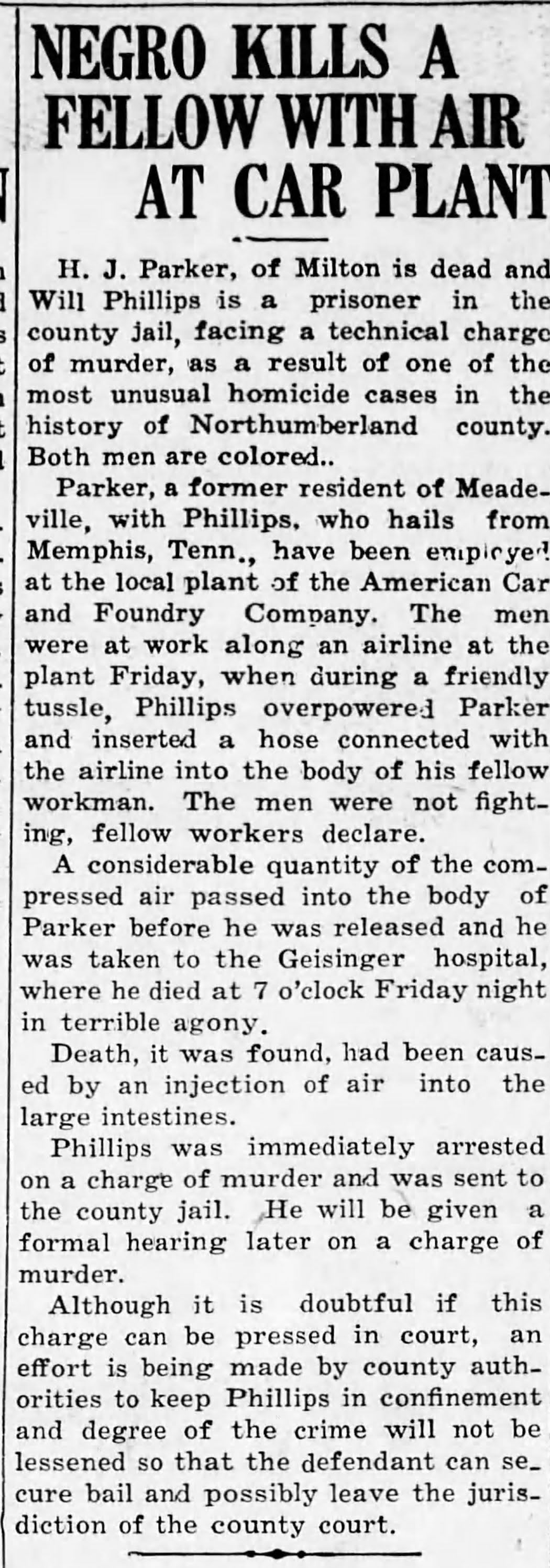
Accidental Murder At AC&F, 1923


According to the Danville Morning News:
"Parker and Phillips, who were employed in the tank department of the Milton plant, were cutting capers with an air hose when Phillips pressed the hose against Parker's body.  The hose had a very high air pressure and Parker was tossed some distance by the  force and mutilated."

"Fellow workmen claim that there were no bad feeling between the two men, and that Phillips and Parker had engaged in a good natured tussle during which the fatal act was committed." - The Miltonian


In August, William Phillips was released from jail, after being fined $50 and ordered to pay the costs of prosecution.  

===================

=================


Iron Ore Discoveries In Milton, 1845 [Milton's Foundries]

The Trego Foundry
[Labeled photo from MiltonHistory.org - an EXCELLENT resource for Milton Pa Historians & Genealogists]

MORE IMPORTANT DISCOVERIES OF IRON ORE. 

Several persons, among whom w as Eli Trego, Esq, of Danville, well known for his extensive and practical knowledge in every thing pertaining to  the Iron business of Pennsylvania, have this week been engaged in making a thorough search for Iron Ore in Union county, near this Borough.

 They announce, as the results of their examination, that they have discovered Iron Ore of the very best qualities and inexhaustible quantities and apparently more favorable for mining operations than any of the neighboring Iron districts.  Several extensive vein of rich Ore were discovered upon the land belonging to  the heirs of Dan Caldwell, four miles above Milton [Daniel Caldwell originated the White Deer & Watsontown Ferry, in 1800] , from thence they traced the Ore in a Southwesterly direction, upon the farms of Messrs. Hatfield, Dersham, Brown, Finny and Spotts, within two and a half miles of Milton.

 The above named gentlemen have all made partial excavation and all without exception realized their most sanguine anticipations in finding veins of rich Ore in apparent abundance.

 The conviction  was forced upon the minds of those engaged in the search that nothing is wanting but men of capital to lay hold of the inducements that so abundantly present themselves, to make the  neighborhood of Milton rival in a very short time any of the other  Iron districts of the  State in enterprise and successful manufacturing operation. 

A more desirable location for Furnaces, Rolling mills, Factories, &c, can  hardly be conceived than that  of the Caldwell property at the mouth of White Deer Creek, a water power surpassed probably by none in the  State, and Ore, Limestone and  Wood in abundance, separated from the  Canal only by the width of the Susquehanna river, the enterprising capitalist can I hardly ask for greater or more permanent inducement than are held out for profitable investments -  Miltonian


Map of Milton Pa, 1850, showing the Trego Foundry

============

The Foundries
As mentioned in the Reminisces Of Milton by Kohler

"The Trego foundry was opposite the grist mill, while the Lawson-Mervine foundry was just above Market street, be-tween the Canal and Arch street. Heavy "pigs" of iron were piled along the canal bank, together with old stoves and other junk in piles ready , for the melting pot within. It was the same at Trego's, though there was not so much of it.

Both of these foundries turned out the several castings used in plows, sled runners for boys, wagon wheels, washers, quoits, griddles and smaller articles needed in machine or construction work. Heavy pieces, like draw-heads and car wheels were cast later at the car works, which seemed to absorb these smaller foundries.

New sled runners and wagon wheels made both of these foundries accessible to the boys, who were permitted to watch the patterns go into the sand boxes and the molten metal fill the space when the patterns were removed.

Cold weather quickly snapped the sled runners then in use, and a wheel could be broken or stolen or lost from the wagons, so that this trade was not to be sneezed at, and the boyish heart palpitated with anxiety lest his new runner would not come out of the sand just right.

The grandfather of your present Burgess made patterns for such foundry work, and it was one of the places where the finer sort of wood working could be watched. He was just overhead ,at one time, of the place where the plow handles were made by Jimmie Longan and others.

The knowledge I gained from watching these foundrymen, came handy while trying a death case in Brooklyn. The man was killed by the fall of a derrick boom on his head while he was unloading Belgian blocks from a scow at a Brooklyn wharf. At the top of the derrick mast was an iron ring with three eyes, to one of which the steel rod supporting the swinging boom was attached by a shackle. This eye gave way, with a load of stone at the end of the boom, and the question of negligence, alleged against the employer, was whether the ring with the eye that broke was made of cast or wrought iron. Upon examination of the break, the grain and appearance brought me back to my iron sled runner days, where the breaks were similar in grain and appearance. I picked up in the cellar of my office building several broken castings, and insisted in court that the ring was not wrought iron, as the defendant claimed, but cast iron, and never intended to carry the load which broke it Out of four days' trial, two days were devoted to expert testimony on the one question of whether the ring was wrought or cast iron, the defendant's expert claim-ing that the hammer marks, when it was made on the anvil, showed that it was wrought. The judge let the jury decide, afterwards remarking to me that he was surprised that I knew so much about iron.. I laughingly replied that in my younger days I had bought cast iron and saw it made in the foundry.

The widow won, but I was never certain that it was cast iron, though my experts swore that such a ring could have been moulded in any first class foundry. I know that Mr. Rhoads could have made the pattern and that it might easily have been moulded in either the Trego or Lawson foundry."
Read more here:

===================
Find More Stories & History Of Milton

==========
READ MORE
==========

=================

Fire at the Trego Foundry, April 1857

On June 22nd 1861, the foundry in "upper Milton", owned by E.S. Trego, burned to the ground.

The foundry was rebuilt - The Miltonian reported in December of 1870 that John K. Trego succeeded E.S. Trego in ownership of the Milton Foundry.

1872
Robert Correy, J.F. Foust, and Henry F. Bailey purchased the Trego foundry and added a saw mill to the business

"The castings for the saw mill were furnished by Trego and Brother, and were very cumbrous and costly, the amount paid for them being equal to the price of the two lots of ground on which the mill stood" - 1873, the first Steam Saw Mill in Milton Pa

1892 - The Trego Foundry For Sale

June 29 1888
"E.S. Trego wore a Gen Harrison badge to celebrate the inauguration of President Harrison, at Milton Pennsylvania, where Mr. Trego resided at the time."

Eli S. Trego was born in Unionville, and moved to Milton where he engaged in the iron business until 1873, when he "came to Reading and lived a retired life here."  He died in 1893, at 85 years of age.
He had been a lieutenant-colonel in Governor Pollock's staff.


"Mr John Trego, the father of William O, and his brother Skiles built and operated a foundry in Milton which was in later years known as the Bickel and Baily Foundry."

June 28 1845


Biking The Ironton Rail Trail


The Saylor Cement Kilns, on the Ironton Rail Trail, located approximately 1 hour and 45 minutes to the south east.

This 13 mile paved rail trail is full of historical artifacts and interesting sights. It's very much a city bike path, with several busy road crossings, and many housing developments along the trail providing crowds of people out for a Sunday stroll.  There is also a very active gun club providing a cacophony of gunfire along one section, making it perhaps the most unique bike path we've ever visited.  

Read more about the Cement Kilns here:

Without actually researching the trail, I somehow had the idea that we would be biking around a series of kilns.  Which, technically we sort of  did - but we also parked right beside them.  

The kiln area is basically a small interpretive park, which happens to be alongside the path. 

 In other words, if you just want to see the cement kilns, you do not have to bring your bike, nor will you need to walk far. They are all grouped right together, right beside a large parking area.

See the trail map, and also an interpretive historical map, here:

If you do wish to bike the trail, it is  is 13 miles long - There is a 5 mile loop, and a 4 mile (4 miles out, then 4 miles back)  spur.  There are a variety of  historical artifacts along the way, and there is an interactive historical map available online.  There are quite a few geocaches along the way too.

It's a paved, easy trail, the biggest obstacle being the crowds, and dogs on retractable leashes darting in front of your bike.  Everyone was polite and friendly, with many of the local residents obviously taking pride in the trail, and several asking us if we needed directions, when we were stopped at various points for the geocaches and historical signs.

If you are not biking, but just stopping to see the kilns, a short walk will take you to this cement phone booth, another extremely interesting sight along the trail.

"This Block Phone was located 99.6 miles from Lehigh Valley Railroad's Liberty Street Ferry Terminal in New York City. The LVRR started putting them in around 1903 and by 1910, they began dispatching by telephone. The Block Phones eliminated the need for a telegrapher. A train could stop, call the tower man on each end and get orders to go out. They didn't need to have a telegrapher with them to attach wires and a telegraph."

The path does cross quite a few busy roads on the extension, as is typical for many of the rail trail paths.  There was one crossing in particular, near the end of the extension that would have given me pause had we been biking with small children, but in most cases, it was not difficult to cross.  

Directly across from this green ironton railroad car is a gravel path.  Here we took a short detour for a geocache, and immediately we left the crowds.  

We did not see a single other person on this side path.  There were a few large grassy fields, and some great old ruins.

There were a variety of neat old structures right along the main trail though, too.  

There were several interpretive signs along the way too.


  On the extension, or spur,  you bike alongside the gun club property for a good stretch.  It's obviously perfectly safe, with large cement walls blocking the property from the path.

 Biking this area was a bit...  disconcerting.  This was not a few random shots, bur rather a steady barrage of gunfire, at a volume loud enough that conversation in this section would have been possible, but difficult. This was the one section of the trail where we did not pass too many crowds of people.

The Troxell Steckel House

We made a quick, brief, detour off the trail to see the Troxell-Steckel home, which is visible from the trail.  Dan's 7th great grandfather is widely reported to have build this home, although the inscription mentioning Maria Magdalena gives me pause.  But, as Dan is descended from two different Troxell lines in this area, I have little doubt he is related to whichever Troxell did actually build this structure.

Many different housing developments line the trail, and its obvious that the many, many residents not only use the trail, but decorate areas of it with benches, flowers, and garden knick knacks.  

At the end of the spur, or extension, is a nice paved parking area, with a pavillion.
A sign at the pavilion shows some of the old buildings and gives some of the history.

The local boy scout and girl scout troops were utilized as well, with an Eagle Scout project displayed nearly every half mile, in sections.  

The mural here was a girl scout Silver Award project.

Although I personally struggled with biking through the throngs of people, and felt like I was using my brakes more than the pedals for much of the trip, there were quite a few more serious bikers along the way who were doing just fine.  Again, everyone was exceedingly polite, which is so unusual that I can't neglect to mention it.  I would frequently hear "on your left" as a more serious biker passed through where others were walking, or where I had slowed down to read the historical markers.  

A dog on a retractable leash did nearly clothesline me, as it darted across the path and up a small bank beside the trail, running right in front of my bike.  But the woman who had been stopped chatting alongside the trail was obviously more upset by this than I was myself. The brakes on my bike worked just fine, and no one was too close behind me, so it was all ok. 

Overall it's a really, really nicely maintained city walking path, and it was nice to see so many out taking advantage of it. 

=====================
Places To Bike


Sunday, June 20, 2021

Fowlersville Covered Bridge At Briar Creek Lake

Fowlersville Covered Bridge, Columbia County Pa

The Fowlersville Bridge a 30 foot span Queen Post  bridge, was built in 1886.It was constructed by a local resident, Charles King.

Originally, the bridge crossed the west branch of Briar Creek. 100 years after it was constructed, the bridge was moved 3 miles east to the Briar Creek Lake Park.


================

An Index Of Covered Bridges In The Susquehanna Valley
https://susquehannavalley.blogspot.com/2019/05/the-covered-bridges-index.html